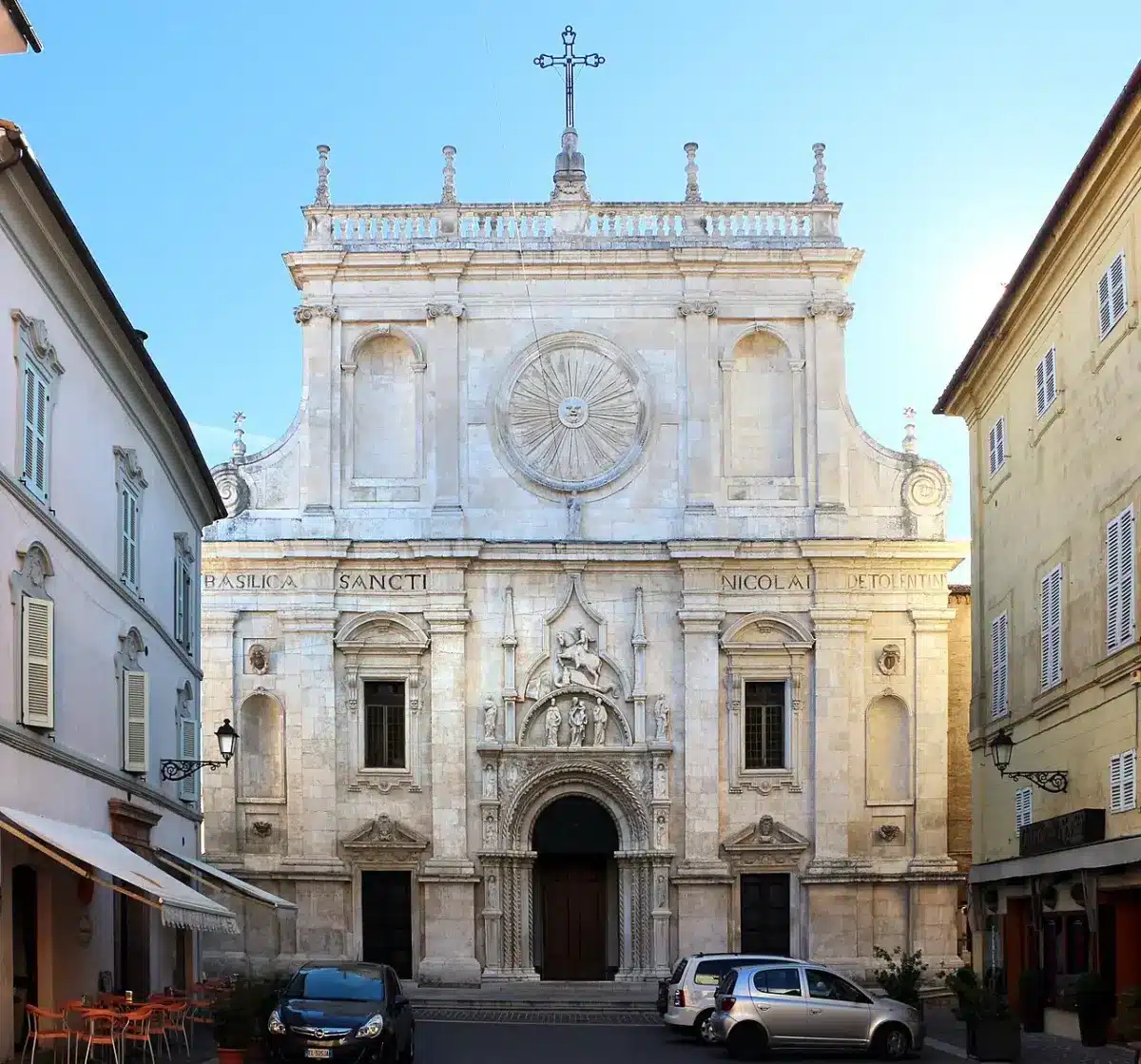
Tolentino is a medieval art town in the province of Macerata, in the middle Chienti valley of central Marche. It is worth visiting for the Basilica of San Nicola and its Cappellone, a fresco cycle from the 1320s that reopened in September 2026 after ten years, plus the Devil’s Bridge, Rancia Castle and a museum of humor in art.
Tolentino: key facts
- Region and province: Marche, province of Macerata, in the middle Chienti valley (Italia.it), 228 meters above sea level (Macerata by Marche)
- From Ancona: direct regional trains in about 1 hour 30 to 1 hour 40 minutes (RFI Tolentino timetable)
- From Rome: no direct train; take an Intercity to Fabriano (about 3 hours) and a regional train on to Tolentino (about 1 hour) (RFI Fabriano timetable)
- Best for: 14th-century frescoes, castles, Napoleonic history, a one-of-a-kind caricature museum and an easy pairing with Fiastra Abbey
- How long to spend: half a day for the town, a full day with Rancia Castle and Fiastra Abbey
Tolentino is one of our neighbors. Our base in Castelraimondo is a few stops up the same railway line, about 25 minutes away by regional train (RFI timetable), so this is a town we know well and visit often. We design private Marche tours, and in autumn 2026 Tolentino has a very good reason to be on your list: one of the great fresco rooms of medieval Italy is open again.
Where is Tolentino, Italy?
Tolentino is in central Marche, on the Adriatic side of central Italy, in the province of Macerata. It sits in the middle valley of the Chienti river (Italia.it).
The town is much older than its medieval look suggests. It was a Piceni settlement, as the many necropolises found in the area show, then a Roman municipium, and long stretches of its 13th-century walls still enclose the historic center (Marche Region tourism). For centuries it mattered because it stood on the Via Lauretana, the main road of the Papal States (Macerata by Marche). Today it is also a working town with a living craft tradition in leather tanning, which since the 1950s has shaped its newer neighborhoods (Italia.it).
Is Tolentino worth visiting?
Yes, especially now. The Cappellone of San Nicola, which the Bishop of Macerata and Tolentino calls “the Sistine Chapel of 14th-century Marche”, reopened on 10 September 2026 after about ten years of closure (Comune di Tolentino).
We also want to be honest about the earthquake of October 2016. It damaged the basilica and several museums, and recovery is still under way: the regional tourism site notes that the historic center, monuments and municipal museums are only partially accessible (Marche Region tourism). The Napoleonic museum in Palazzo Parisani Bezzi has been closed since the earthquake (ViviTolentino), and the Sanctuary Museum of San Nicola is temporarily closed (Tolentino Musei Civici). What is open, though, is more than enough for a rewarding day, and you will see a town that is rebuilding with care.
What to see in Tolentino
The main sights of the old town are within a short walk of each other, with Rancia Castle a short drive outside. This table sums them up; the details follow.
| Sight | What it is | Time needed | Our tip |
|---|---|---|---|
| Basilica of San Nicola and the Cappellone | Major Augustinian sanctuary, consecrated in 1465, with a fresco room from the 1320s | 1 to 1.5 hours | Do not skip the 14th-century cloister |
| Piazza della Libertà and the clock tower | The main square, with a tower whose dials show the hours, the day and the phases of the moon | 20 minutes | Find a café table and read the four dials |
| MIUMOR | International Museum of Humor in Art, with more than 4,000 original works | 1 hour | From October to April it opens only in the afternoon from Tuesday to Thursday |
| Porta and Ponte del Diavolo | A 13th-century gate and the bridge of the devil legend | 30 minutes | Walk down in the evening for the best photos |
| Cathedral of San Catervo | The cathedral of the patron saint, with a 4th-century sarcophagus | 30 minutes | Ask to see the Roman-era sarcophagus chapel |
| Castello della Rancia | A 14th-century castle 7 km from the center, now a museum | 1 to 1.5 hours | Pair it with Fiastra Abbey in the same afternoon |
The Basilica of San Nicola and the Cappellone
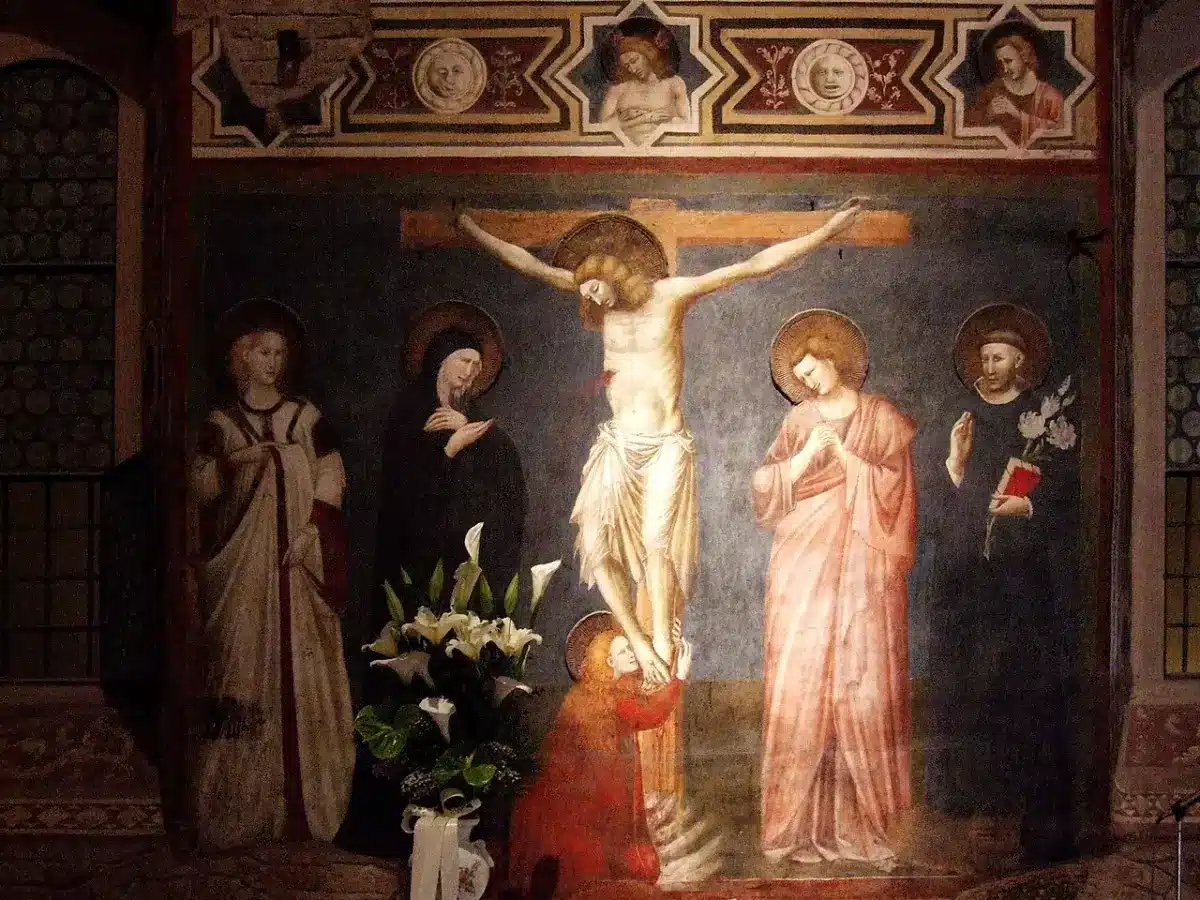
The basilica is one of the most important sanctuaries in central Italy. It is dedicated to Saint Nicholas of Tolentino (1245 to 1305), an Augustinian friar, preacher and miracle worker who lived in the town’s convent from 1275 until his death and was canonized in 1325. He is venerated as the patron of the souls in Purgatory and a protector of mothers and young children. The church was consecrated in 1465; its carved wooden coffered ceiling and eight side chapels date from the 17th century, and it holds works such as a Saint Anne by Guercino (Marche Region tourism). Look closely at the main portal by the Florentine sculptor Nanni di Bartolo, and then walk into the Augustinian cloister from the first half of the 14th century, described as the oldest cloister of the mendicant orders in Italy (Marche Region tourism).
The highlight is the Cappellone. Its frescoes, painted in the 1320s and attributed to a workshop from Rimini led by Pietro da Rimini, are one of the largest and best-preserved painted cycles of the early 14th century. The four sections of the vault show the Evangelists with the Doctors of the Church, while the walls tell the stories of the Virgin, of Christ and, in the lowest band, of Saint Nicholas, with the Crucifixion above the altar. In the center stands a stone ark commissioned in 1474 to hold the saint’s remains; it never did, because the body had been hidden underground after an attempted theft. After the 2016 earthquake, restorers removed the temporary protections, consolidated detached plaster and brought back the original colors, and the room reopened on the saint’s feast day, 10 September 2026 (Comune di Tolentino). Works on the rest of the basilica continue: the facade, bell tower and roof are done, and the apse is being completed.
The basilica is an active place of worship, so dress respectfully and avoid visiting during Mass. For current opening times, check the official sanctuary website.
Piazza della Libertà and the MIUMOR museum
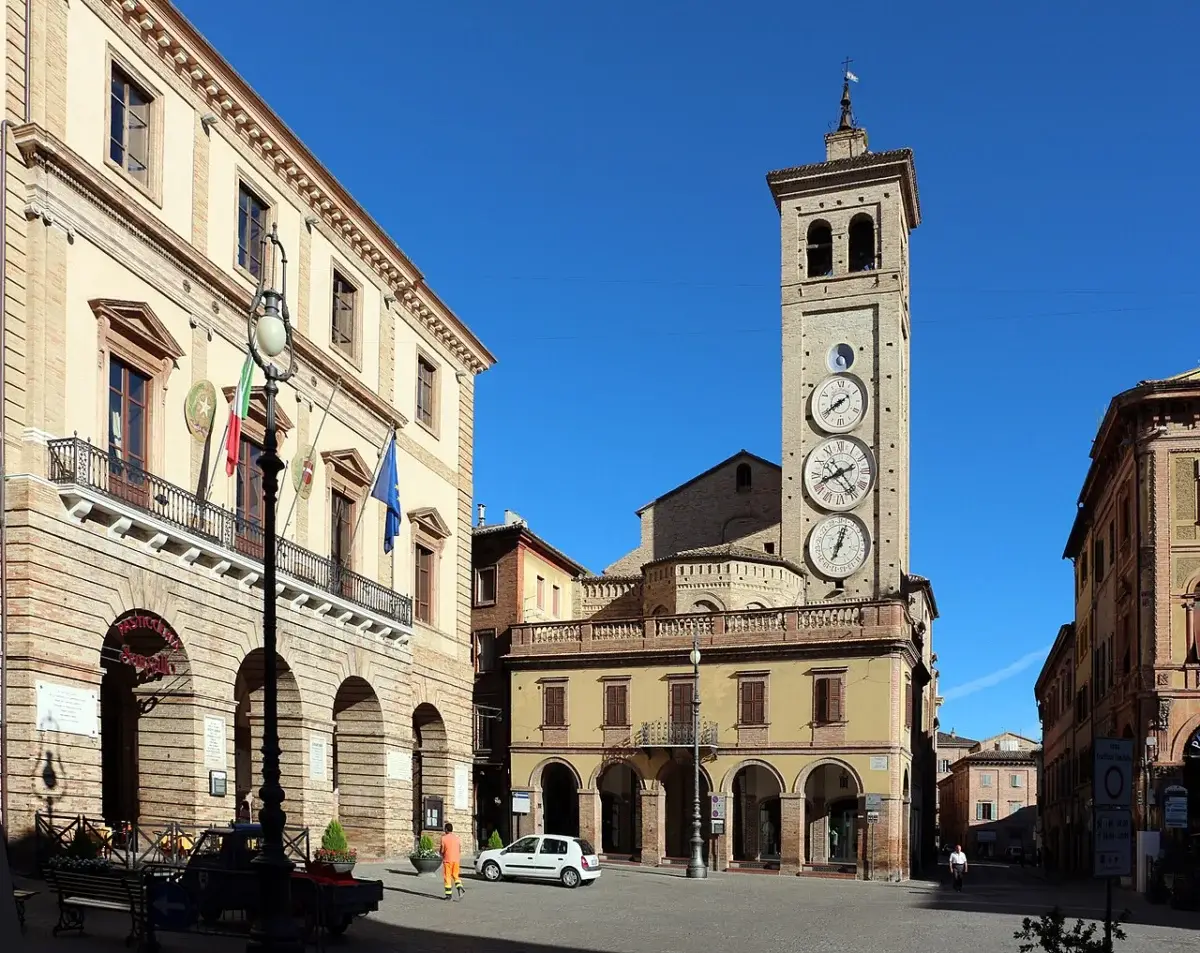
Piazza della Libertà has been the town’s living room since Roman times. Around it stand Palazzo Sangallo, the town hall, rebuilt in the mid-1800s over the 14th-century civic palace, and the clock tower, a 16th-century tower heavily remodeled in the 1800s, whose dials mark the hour, the day and the phases of the moon (Italia.it).
Inside Palazzo Sangallo is the MIUMOR, the International Museum of Humor in Art, the only museum of its kind in Italy and one of the few in the world. It was founded in 1970 by Luigi Mari, a former mayor, doctor and artist who in 1961 had launched the Biennale of caricature, and it now holds more than 4,000 original drawings, paintings, sculptures and prints. From October to April it is closed on Mondays, open Tuesday to Thursday from 2:30 to 5 pm, and Friday to Sunday from 10:30 am to 12:30 pm and 2:30 to 5 pm (Tolentino Musei Civici). A full ticket costs €5, and a combined pass with Rancia Castle costs €9; children up to 11 enter free (official tickets).
Porta del Diavolo and Ponte del Diavolo
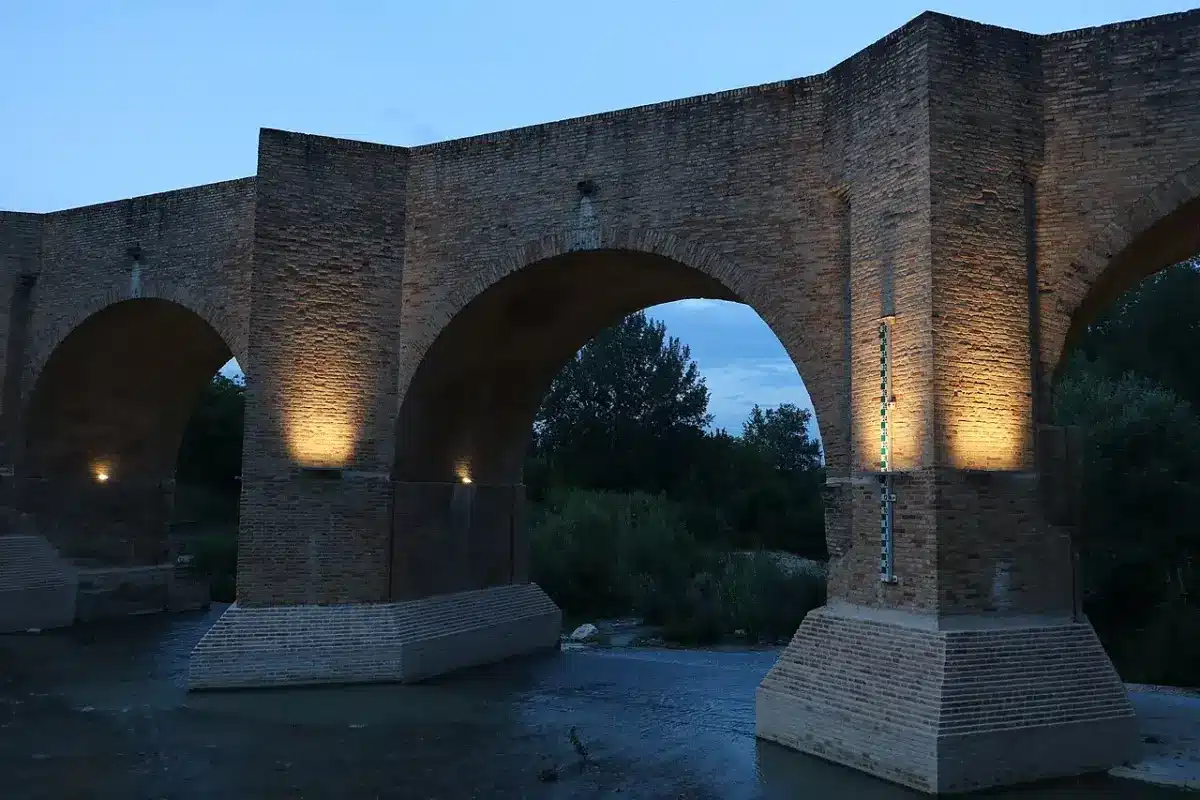
The best way into Tolentino is through the Porta del Diavolo, the Devil’s Gate, a 13th-century entrance in the well-preserved walls that leads to the Ponte del Diavolo (Italia.it). Legend says the bridge was built in a single night in 1268 (Macerata by Marche) with the devil’s help, in exchange for the soul of the first living being to cross it. The builder turned to Saint Nicholas, who on opening day arrived with a little dog and a wheel of cheese; he threw the cheese across, the dog ran after it, and the devil was cheated (Marche Region tourism). Guests love this story, and it makes a fun start to a walk with children.
The Cathedral, Palazzo Parisani Bezzi and Teatro Vaccaj
The Cathedral of San Catervo is dedicated to the town’s patron and keeps the large 4th-century sarcophagus of Saints Catervus and Septimia in a chapel with Renaissance frescoes (Macerata by Marche). Nearby, Palazzo Parisani Bezzi is where the Treaty of Tolentino between Napoleon Bonaparte and the Papal States was signed in February 1797, and the 18th-century Teatro Vaccaj is still the town’s stage (Marche Region tourism). With that treaty Napoleon forced Pope Pius VI to give up land and money (Italia.it). Look out also for the Art Nouveau Palazzo Politeama (Italia.it).
Castello della Rancia
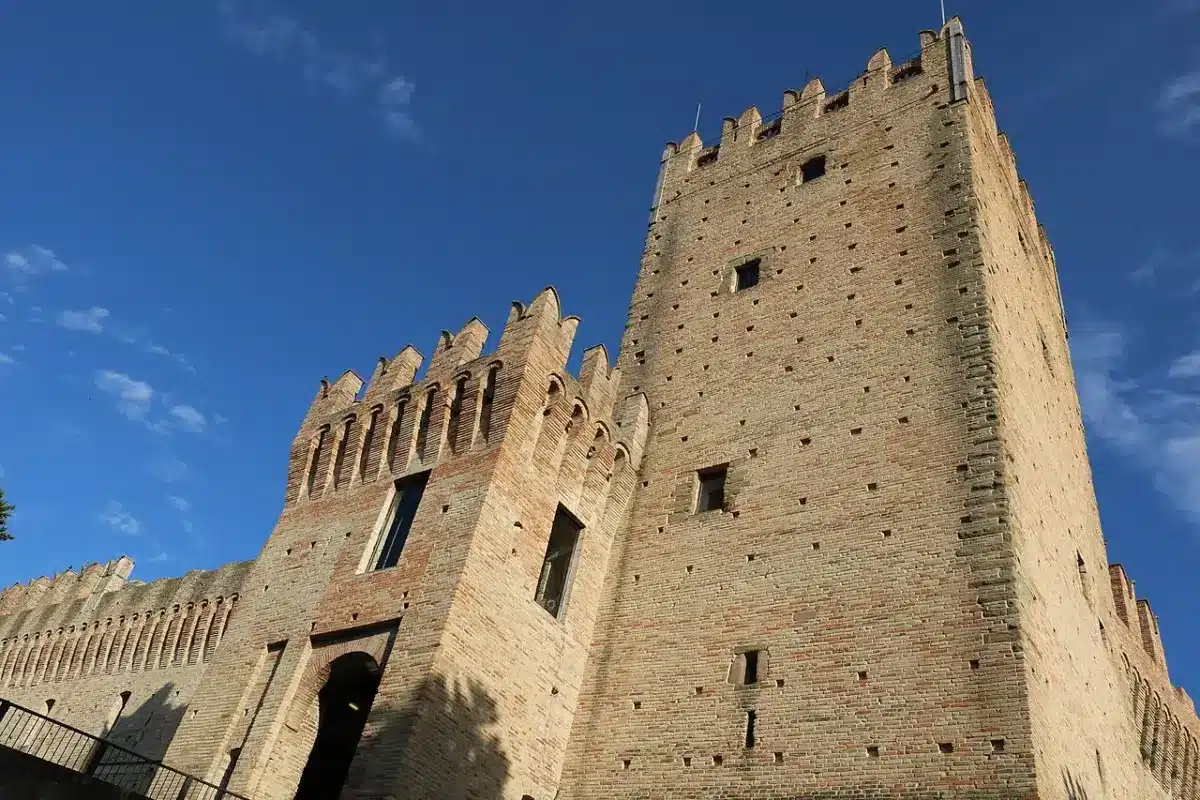
Just 7 km from the center, before you enter Tolentino, stands Castello della Rancia (Marche Region tourism). Rodolfo II da Varano, lord of Camerino, had it built between 1353 and 1357 as a family residence, a fortified granary and an outpost over the main road. The central keep, about 25 meters tall, is probably all that remains of the original building. The castle passed to the Jesuits in 1581, and the town bought it in 1973 (Comune di Tolentino).
Today it houses the civic archaeological museum, with Piceni and Roman finds, and a permanent exhibition on the Compagnia della Rancia, the theater company famous in Italy for its musicals. The castle is also linked to the Battle of Tolentino of 2 and 3 May 1815, when the Austrians defeated Joachim Murat, King of Naples and Napoleon’s brother-in-law; the battle is re-enacted every three years (Tolentino Musei Civici). The castle is closed on Mondays and opens with shorter hours from October to April, so check the official page before you go. A full ticket costs €6 (official tickets).
Want to see Tolentino as part of a private Marche trip? We can book a licensed guide for the Cappellone, plan a long lunch in the countryside and add Rancia Castle and Fiastra Abbey in the afternoon, all at your pace. See our private Marche tours.
How to spend one day in Tolentino
This is the plan we would follow with guests on a Friday, Saturday or Sunday, when the MIUMOR is open in the morning as well as the afternoon.
- 9:30 am: enter the old town through the Porta del Diavolo and cross the Ponte del Diavolo.
- 10 am: the Basilica of San Nicola, the cloister and the newly restored Cappellone.
- 11:30 am: coffee on Piazza della Libertà under the clock tower, then the MIUMOR before it closes at 12:30 pm.
- 1 pm: lunch with vincisgrassi, the baked pasta of the Macerata area.
- 2:30 pm: a short drive to Castello della Rancia for the keep and the archaeological museum.
- 4 pm: on to Fiastra Abbey for the Cistercian church and a walk in the nature reserve before closing time.
- Evening: back to Tolentino for a stroll past the Cathedral and dinner, or on to Macerata for the night.
What food is Tolentino known for?
Tolentino eats like the rest of the Macerata area, and that is good news. Italia.it lists vincisgrassi, fried olives and ciauscolo among the best-known dishes typical of the Macerata area (Italia.it):
- Vincisgrassi: seven hand-rolled layers of pasta with béchamel and a rich giblet-flavored meat sauce
- Ciauscolo: the local salami, a classic of the Macerata table, perfect with bread and a glass of local red
- Fried olives: stuffed with meat, breaded and fried, often served with fried custard cubes called cremini
Inside the Fiastra Abbey reserve you will also find bars, restaurants and gift shops (Fiastra Abbey Nature Reserve). If food is the heart of your trip, have a look at our Italy food and wine tours.
How to get to Tolentino
Tolentino has its own station on the Civitanova Marche to Fabriano railway (Regione Marche), so you can reach it by train, though a car or private transfer is far more flexible for the sights outside town.
- From Ancona: direct regional trains run via Civitanova Marche and Macerata; for example, a weekday train leaving Tolentino at 5:05 pm reaches Ancona at 6:43 pm (RFI Tolentino timetable, valid to 12 December 2026).
- From Rome: Intercity trains link Roma Termini and Fabriano in about 3 hours, and regional trains from Fabriano reach Tolentino in about an hour (RFI Fabriano timetable).
- From Camerino and Castelraimondo: about 25 minutes by regional train (RFI timetable).
Check exact times on Trenitalia before you travel. Rancia Castle and Fiastra Abbey are outside town and not easy to combine by public transport in one day. On our trips, our own drivers take you there. If you prefer trains and buses, read how to spend two weeks in Marche without a car.
When is the best time to visit Tolentino?
Late spring and September are the sweet spot, with mild weather and longer museum hours, while early September brings the town’s biggest religious feast. Autumn is quiet and a lovely time to see the restored Cappellone without crowds.
- May to September: Rancia Castle and the MIUMOR keep their summer hours, still closed on Mondays (Tolentino Musei Civici).
- July: the “Città di Tolentino” choral music festival brings Italian and international choirs to town every year (Marche Region tourism).
- 10 September: the feast of Saint Nicholas, the day the Cappellone reopened in 2026 (Comune di Tolentino), followed by the Feast of Forgiveness in the Cappellone (Comune di Tolentino).
- Every two years: the International Biennale of Humor in Art, the town’s most important event, with satirical artists and cartoonists from around the world (Marche Region tourism).
Autumn is also truffle and harvest season across inland Marche; read why we think Marche is Italy’s best autumn destination.
What is near Tolentino?
The best pairing is Fiastra Abbey, the Cistercian abbey of Chiaravalle di Fiastra, founded in 1142 by monks from Chiaravalle near Milan (Abbadia Turismo). It sits in the Fiastra Abbey Nature Reserve, established in 1984 over 4,448 acres in the municipalities of Tolentino and Urbisaglia. The abbey is open every day from 10 am to 1 pm and 3 to 6:30 pm (6 pm in winter), and an adult ticket costs €5 (official visitor information).
Next door, the Archaeological Park of Urbs Salvia at Urbisaglia preserves a Roman theater that is one of the largest in Italy, along with a temple, walls and an amphitheater (Fiastra Abbey Nature Reserve). Up the valley, Camerino and San Severino Marche are a short hop by train, and Macerata, with its summer opera festival, is just down the line. Tolentino is also a natural stop on the way into the Sibillini Mountains National Park, whose headquarters are in Visso, in the same province (Sibillini National Park).
In a Marche itinerary, Tolentino works best as a full day from a base in the Macerata hills, between the Conero coast and the mountains. Our guide to the most beautiful towns to visit in Le Marche helps you choose the other stops, and how many days to spend in Le Marche helps you set the pace. For the south of the region, see our guide to Fermo.
Frequently asked questions about Tolentino
Is Tolentino, Italy worth visiting?
Yes. Tolentino has the Basilica of San Nicola with the Cappellone, one of the largest early 14th-century fresco cycles in Italy, reopened on 10 September 2026, plus the Ponte del Diavolo, the MIUMOR museum of humor in art and Castello della Rancia just outside town.
Where is Tolentino in Italy?
Tolentino is in the Marche region of central Italy, in the province of Macerata, in the middle valley of the Chienti river, between the Adriatic coast and the Apennines.
What is Tolentino famous for?
Tolentino is famous for Saint Nicholas of Tolentino, the Augustinian friar who lived there from 1275 until his death in 1305, for the Treaty of Tolentino signed by Napoleon and the Papal States in 1797, and for the Battle of Tolentino of 1815, when the Austrians defeated Joachim Murat.
Is the Cappellone of San Nicola open after the earthquake?
Yes. After restoration work following the 2016 earthquake, the Cappellone reopened on 10 September 2026, the feast of Saint Nicholas. Work on other parts of the basilica continues, and the Sanctuary Museum is temporarily closed.
How do I get to Tolentino from Ancona or Rome?
From Ancona, direct regional trains reach Tolentino in about 1 hour 30 to 1 hour 40 minutes. From Rome, take an Intercity to Fabriano, about 3 hours, then a regional train to Tolentino, about 1 hour.
How long should I spend in Tolentino?
Half a day covers the basilica, Piazza della Libertà, the MIUMOR and the Ponte del Diavolo. Plan a full day to add Castello della Rancia and Fiastra Abbey nearby.
Plan your visit to Tolentino with locals
Sweet Life Italy is a certified incoming tour operator of the Marche Region, based in Castelraimondo and founded by Marco and Ilaria, who live in Marche. We design private, tailor-made trips for 1 to 7 guests across Marche and the rest of Italy, with licensed guides, local food experiences and our own drivers, and we bring more than 13 years in luxury tourism to every itinerary. Tolentino can be one memorable day of a wider private Marche tour or part of one of our private luxury tours of Italy.
Tell us about your trip and we will start with a free video call. After that we send a day-by-day proposal and a free first estimate. Please allow at least 8 weeks before your travel dates.
Featured photo: the facade of the Basilica of San Nicola in Tolentino, by Sailko via Wikimedia Commons, CC BY 3.0.