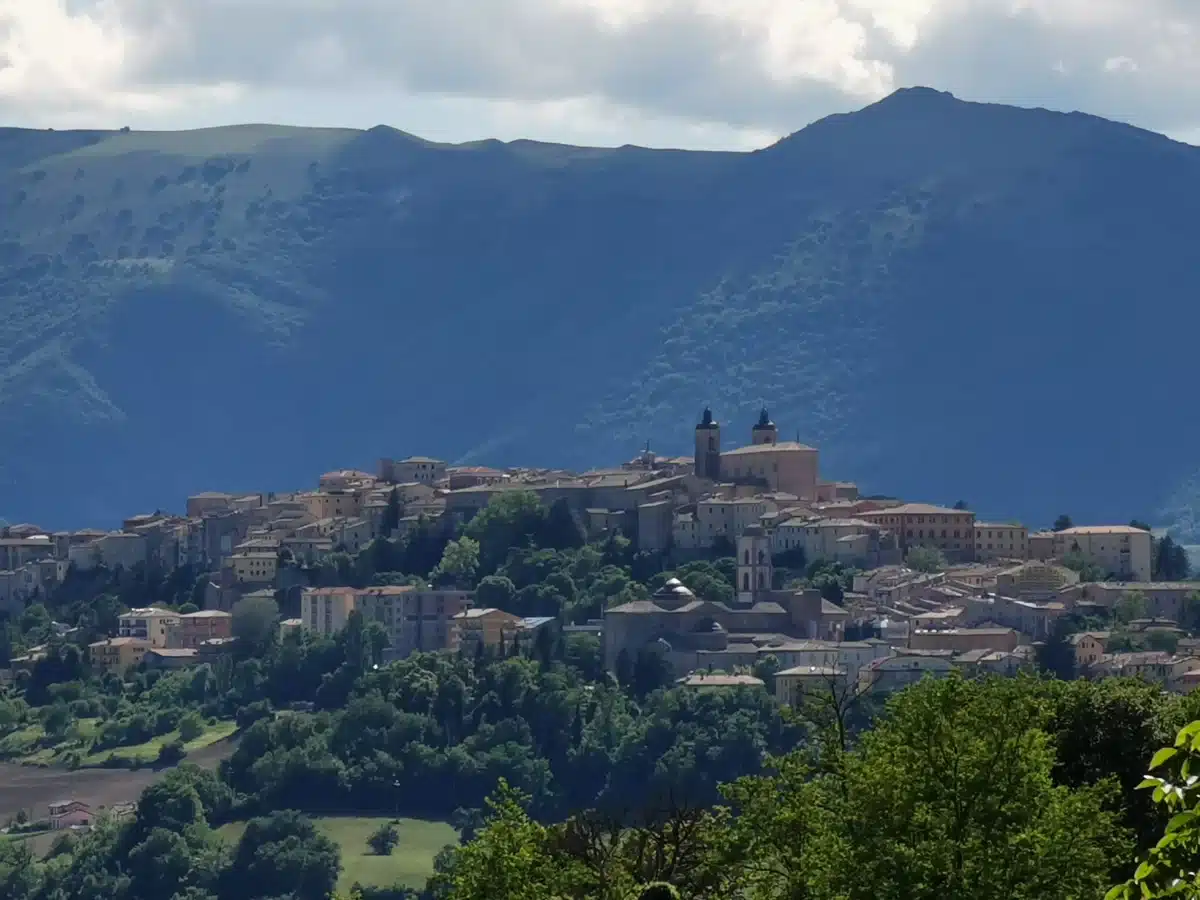
Camerino is a walled hill town of the Da Varano dukes in the province of Macerata, in inland Marche, set on a ridge between the Chienti and Potenza valleys with the Sibillini Mountains on the horizon. It is worth visiting for its medieval university, Renaissance art, mountain views and a community rebuilding with real pride after the 2016 earthquake.
Camerino: key facts
- Region and province: Marche, province of Macerata, at about 670 meters above sea level (University of Camerino)
- From Ancona: about 1 hour 15 minutes by road from Ancona Falconara airport (University of Camerino)
- From Rome: about 4 hours by train: Roma Termini to Fabriano in about 3 hours, then 30 minutes to Castelraimondo-Camerino station and a 10-minute bus ride up the hill
- Best for: Renaissance art, medieval festivals, local food (torrone and truffles) and a quieter base near the Sibillini
- How long to spend: half a day for the center, a full day with the museums and the surrounding castles
We live a few minutes away: the train station that serves Camerino is in Castelraimondo, our home town and the base of Sweet Life Italy. This guide is what we tell friends in 2026, including what has reopened since the earthquake and what is still behind scaffolding. If you would like to see it as part of a trip, we design private Marche tours around towns like this one.
Where is Camerino, Italy?
Camerino is in central Marche, in the province of Macerata, on the eastern side of the Apennines near the border with Umbria. According to Italia.it, the town stands on a hill between the Chienti and Potenza valleys, between the Sibillini Mountains and Mount San Vicino.
That position shaped its history. It was the capital of the Da Varano duchy, whose castles and fortresses still dot the surrounding valleys. Today it is a university town: the University of Camerino was founded in the Middle Ages and students still set the rhythm of daily life. The altitude also means real seasons: the university warns that winters can be cold and snowy, with temperatures between +10°C and -5°C.
Is Camerino worth visiting after the earthquake?
Yes, as long as you know what to expect. Camerino is a town in the middle of a large reconstruction: several key monuments have reopened, others are still closed, and you will see cranes in the historic center.
The shocks of 26 October 2016 turned the historic center into what the government’s reconstruction office calls “the largest and quietest red zone” of the earthquake area. In its October 2025 update, the office reported that the center had become a busy construction site instead: of 169 expected private rebuilding projects in the historic center, 26 were finished and 36 under way. The same update said the cathedral’s structural work was half done, with reopening expected “within a few years”, and that work on the Ducal Palace (Palazzo Varano) was about to be awarded, with 2026 set as the year building sites open.
What has come back is significant. The Basilica of San Venanzio has reopened, and in October 2025 the Diocesan Museum returned in the restored Archbishop’s Palace on Piazza Cavour (ANSA).
What to see in Camerino
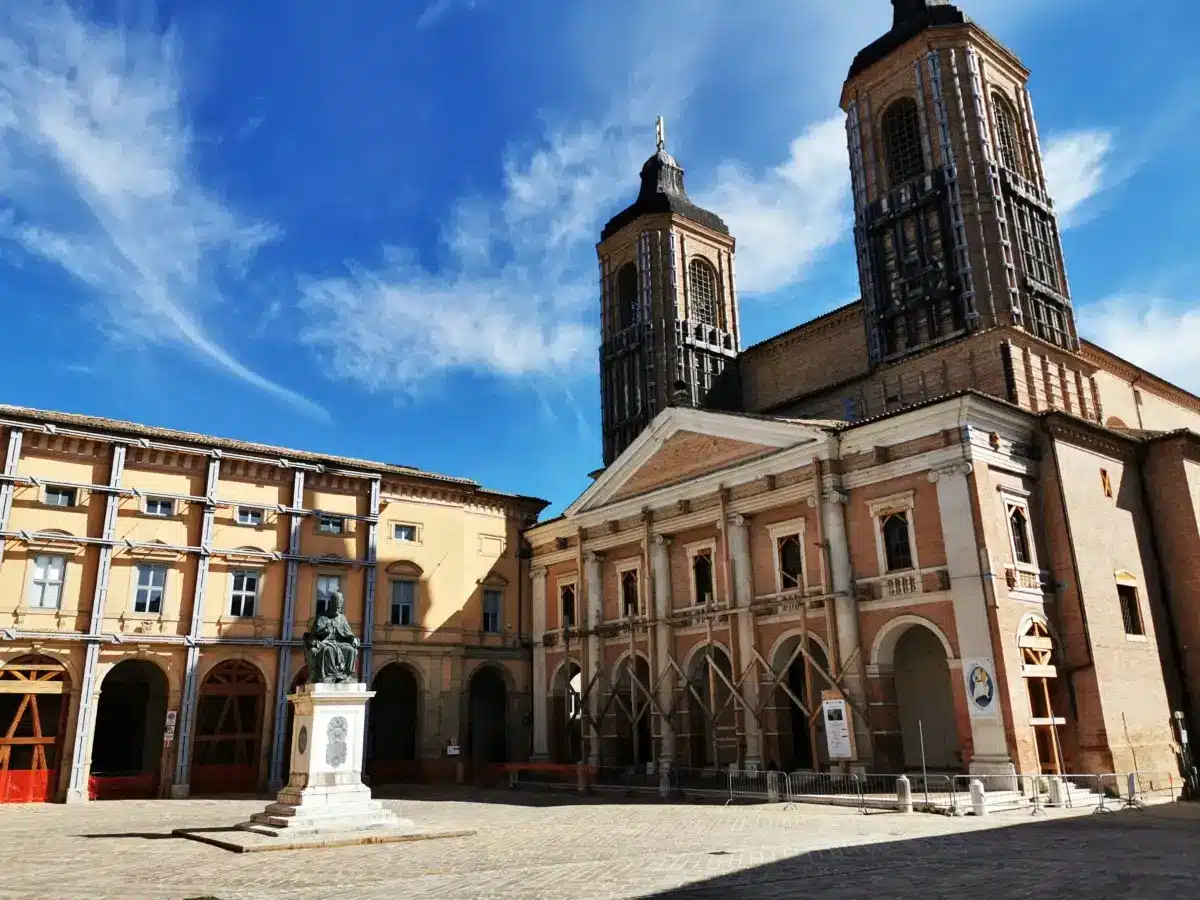
Start in Piazza Cavour, walk to the Basilica of San Venanzio and end at the Rocca for the view. We note where a building is still under reconstruction.
| Sight | What it is | Time needed | Our tip |
|---|---|---|---|
| Piazza Cavour | The main square, framed by the cathedral, the Archbishop’s Palace and the Ducal Palace | 20 minutes | The cathedral and Ducal Palace are still being rebuilt; enjoy the facades and the square itself |
| Diocesan Museum “G. Boccanera” | Sacred art of the archdiocese in the restored Archbishop’s Palace | 1 hour | Free entry, closed on Mondays |
| Basilica of San Venanzio | The patron saint’s basilica, reopened after 2016, with a Tiepolo altarpiece | 30 to 45 minutes | Go down to the crypt to see the saint’s medieval tomb |
| Rocca Borgesca | Cesare Borgia’s fortress of 1503 with a garden and belvedere | 30 minutes | Come late afternoon for the light on the mountains |
| Botanical garden | The university garden founded in 1828 below the town walls | 45 minutes | Check the university’s museum system for current opening days |
| Da Varano castles | Fortresses of the old duchy in the valleys around town | Half a day | Best combined with a drive through the Chienti valley |
Piazza Cavour and the Ducal Palace
Piazza Cavour is the heart of Camerino, where the cathedral, the Archbishop’s Palace and the Ducal Palace face each other. The Ducal Palace, built for the Da Varano family, is known for the Sala degli Sposi with its 15th-century frescoes (Italia.it). It is also the historic seat of the university and, as of the latest official update, is still waiting for its reconstruction to begin, so you can admire it only from outside for now.
The Diocesan Museum
The reopened Museo Diocesano “G. Boccanera” at Piazza Cavour 12 is the easiest way to see Camerino’s art today. The new layout has four sections: frescoes and panel paintings, sculpture, canvases, and gold and liturgical objects. Entry is free and the museum opens Tuesday to Sunday, morning and afternoon; it is closed on Mondays, so check the website for the current hours before you go.
Basilica of San Venanzio
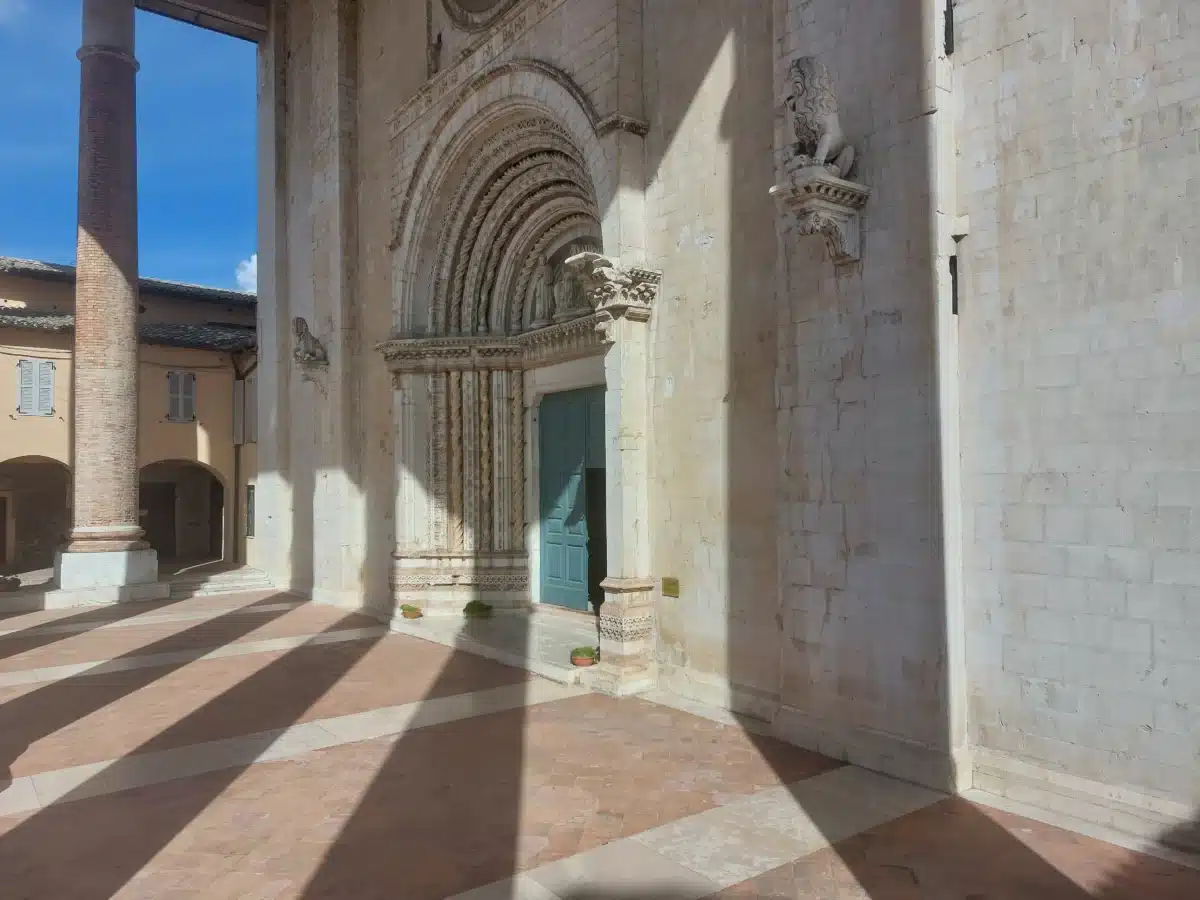
The basilica of Camerino’s patron saint is one of the great comeback stories of the town. According to the town’s official tourism site, it reopened after the 2016 earthquake thanks to restoration funded by the Fondazione Arvedi Buschini of Cremona. Look for the mid-14th-century portal, the silver statue of the saint from 1764 and a 1740 altarpiece by Tiepolo. In the crypt are the saint’s silver urn from the 13th century and his 14th-century tomb.
Rocca Borgesca and the botanical garden
The Rocca Borgesca was built in 1503 by Cesare Borgia to secure his hold on Camerino, and the garden around it is now the town’s favorite meeting place and viewpoint. Below the walls, the university’s botanical garden covers about one hectare and dates from 1828, when the botanist Vincenzo Ottaviani founded it (University of Camerino). The university museum system notes that some of its trees date back to the founding, and that the Marche Region has recognized it as a monumental plant site since 2012.
Want to see Camerino as part of a private Marche trip? We live next door and can plan a day here around what is open that week, with a licensed local guide and a long lunch in the hills. See our private Marche tours.
How to spend one day in Camerino
One day is enough to see the center well. This is the plan we would follow ourselves.
- Morning: coffee in Piazza Cavour, then the Diocesan Museum when it opens (remember it is closed on Mondays).
- Late morning: walk through the old streets to the Basilica of San Venanzio and its crypt.
- Lunch: a long Marche lunch, with truffle dishes if you come in autumn.
- Afternoon: the botanical garden, then a sweet stop for Camerino’s torrone.
- Before sunset: the garden of the Rocca Borgesca for the view over the hills toward the mountains.
- Evening: check the town’s events page; from October to April there is a theater season.
How to get to Camerino
The easiest way to reach Camerino is by car or with a private driver; by public transport you take the train to Castelraimondo-Camerino station and a local bus up the hill. The details below come from the University of Camerino’s travel page and its directions page.
- By train: Castelraimondo-Camerino station is on a branch line from Fabriano, which sits on the main Rome to Ancona line. A bus timed with arrivals takes about 10 minutes to the center. Check times on Trenitalia.
- From Rome: train from Roma Termini to Fabriano (about 3 hours), then the local train toward Civitanova Marche to Castelraimondo-Camerino (about 30 minutes). By car, take the A1 to Orte, then continue via Terni, Spoleto and Foligno on the SS77 to Muccia, and drive the last 10 km.
- From the Adriatic coast: leave the A14 at Macerata/Civitanova Marche, drive west on the SS77 to the Camerino exit, then about 6 km up to the town.
- Nearest airports: Ancona Falconara (about 1 hour 15 minutes by road) and Perugia.
Trains on the branch line are not frequent, which is why a car or a driver makes the day much easier: on our trips, our own drivers take you there and wait while you explore. If you are planning Marche without a rental car, read how to spend two weeks in Marche without a car.
What food is Camerino known for?
Camerino is famous for its torrone, a soft nougat, and the mountain area around it is truffle country. The town’s tourism office runs a guided torrone tasting with Casa Francucci, a maker founded in 1890 and run since 1983 by Paolo Attili, and every January the town holds a Festa del Torrone.
In October, Le Terre del Tartufo brings tastings, cooking shows and workshops to Camerino and the mountain towns of Pieve Torina, Fiastra, Muccia, Serravalle di Chienti and Ussita, with cheeses, cured meats, pasta, wine and torrone alongside the truffles. In June, Il Ducato in un Bicchiere fills the town with stands from local wineries. If food is the reason for your trip, see our truffle hunting guide and our Italy food and wine tours.
When is the best time to visit Camerino?
Late spring and early autumn are the best times to visit Camerino: May brings its great medieval festival, and October brings truffles and mild days. Summer is cooler than the coast thanks to the altitude, while winter can be cold and snowy.
The highlight of the year is the Corsa alla Spada e Palio in May, held for the patron saint San Venanzio. Its roots go back to the 1200s, and its main event is a foot race between the three town quarters, Sossanta, Mezzo and Muralto, to win the sword hanging in the square, with a historical parade, torchlit evenings and taverns serving traditional food. In summer, the Camerino Festival brings music to town. Still to come this year, the official calendar lists the Coricantando choir festival in the Basilica of San Venanzio on 24 October (free entry), a conference marking ten years since the earthquake on 13 and 14 November, and the traditional Christmas concert on 26 December.
What is near Camerino?
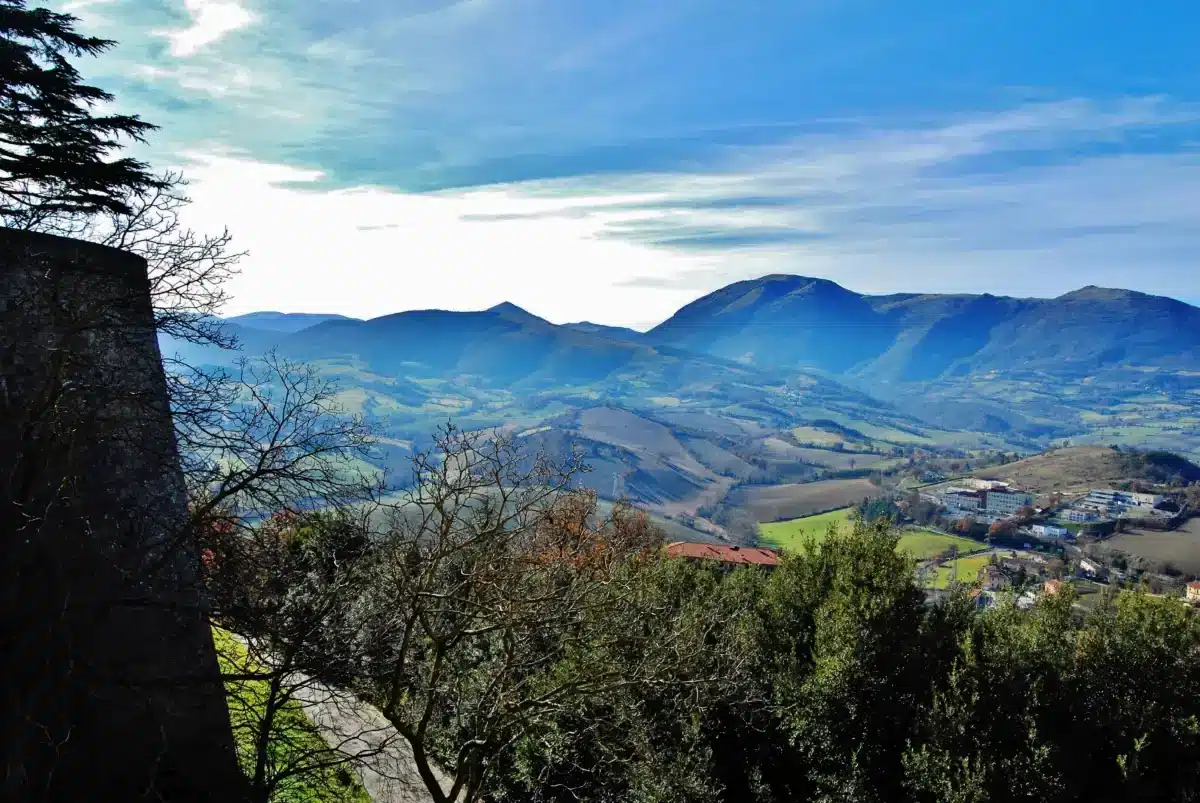
Camerino fits naturally into a wider Marche itinerary. The castles and fortresses of the old Da Varano duchy are scattered across the surrounding countryside (Italia.it), and the mountain towns of the truffle festival, including Fiastra, lead toward the Sibillini.
We like to pair Camerino with other towns of the Macerata hills and, for longer trips, with the art cities of the region. Our guide to the most beautiful towns to visit in Le Marche will help you choose, and how many days to spend in Le Marche helps you plan the pace. Camerino is also close to the Umbrian border, so you can continue into Umbria on the same trip.
Frequently asked questions about Camerino
Is Camerino worth visiting?
Yes. Camerino has Renaissance art, a medieval university, one of central Italy’s most atmospheric historic festivals and wide mountain views. Since the 2016 earthquake some buildings, including the cathedral and the Ducal Palace, are still under reconstruction, but the Basilica of San Venanzio and the Diocesan Museum have reopened.
Was Camerino damaged by the 2016 earthquake?
Yes. The shocks of 26 October 2016 turned the historic center into the largest red zone of the earthquake area. Reconstruction is now well under way: by October 2025 dozens of private rebuilding projects in the center were finished or in progress, and 2026 is set as the year work starts on the main public buildings.
How do I get to Camerino without a car?
Take a train to Fabriano on the Rome to Ancona line, then the local train to Castelraimondo-Camerino station. A bus timed with train arrivals reaches the center in about 10 minutes. A private driver is the simplest option, as trains on the branch line are not frequent.
How far is Camerino from Rome?
By train, allow about four hours: around 3 hours from Roma Termini to Fabriano, 30 minutes to Castelraimondo-Camerino and a short bus ride. By car, the route runs via Orte, Terni, Spoleto and Foligno on the SS77.
What is Camerino famous for?
Camerino is famous for its medieval university, its history as the capital of the Da Varano lords, the Corsa alla Spada e Palio festival every May and its soft torrone nougat.
How long should I spend in Camerino?
Half a day is enough for Piazza Cavour, the Basilica of San Venanzio and the Rocca. Plan a full day if you want to add the Diocesan Museum, the botanical garden, a long lunch and a drive to the Da Varano castles nearby.
Plan your visit to Camerino with locals
Sweet Life Italy is a certified incoming tour operator of the Marche Region, based in Castelraimondo and founded by Marco and Ilaria, who live here. We design private, tailor-made trips for 1 to 7 guests across Marche and the rest of Italy, with guides, tastings and our own drivers, and we bring more than 13 years in luxury tourism to every itinerary. Camerino can be one perfect day of a wider private Marche tour or part of one of our private luxury tours of Italy.
Tell us about your trip and we will start with a free video call. After that we send a day-by-day proposal and a free first estimate. Please allow at least 8 weeks before your travel dates.
Featured photo: Camerino on its ridge, by Sirleonidas via Wikimedia Commons, CC BY-SA 4.0.