Fabriano is a historic town in the province of Ancona, in the green Apennine hinterland of Italy’s Marche region, and it is known worldwide as the city of paper. It is worth visiting for its Paper and Watermark Museum, where master papermakers still make sheets by hand, and for one of the most striking medieval squares in central Italy.
We are Sweet Life Italy, a Marche tour operator run by Marco and Ilaria, who live in the region, and we design private Marche tours where Fabriano is often the morning before the Frasassi Caves. Fabriano is also the railway junction for our own valley, so we pass through it all the time. This guide covers what to see in Fabriano, the 2026 opening hours and tickets, how to get there by train, what to eat, when to go and what is nearby, plus a detail most guides miss: your Paper Museum ticket already includes the town’s art gallery.
Fabriano: key facts
- Region and province: Marche, province of Ancona, in the Apennines near the border with Umbria; a UNESCO Creative City for Crafts and Folk Art since 2013 (Visit Fabriano)
- From Ancona: direct trains take about 55 minutes (Intercity) to 1 hour 20 minutes (regional) (RFI Fabriano timetable)
- From Rome: Fabriano is on the Rome to Ancona line, and direct trains from Roma Termini take about 2 hours 25 minutes to 3 hours (RFI Fabriano timetable)
- Best for: paper and craft lovers, artists, medieval architecture, and anyone combining a town visit with the Frasassi Caves
- How long to spend: half a day for the Paper Museum and Piazza del Comune, a full day if you add the art gallery, the Oratorio della Carità and the cathedral
Where is Fabriano, Italy?
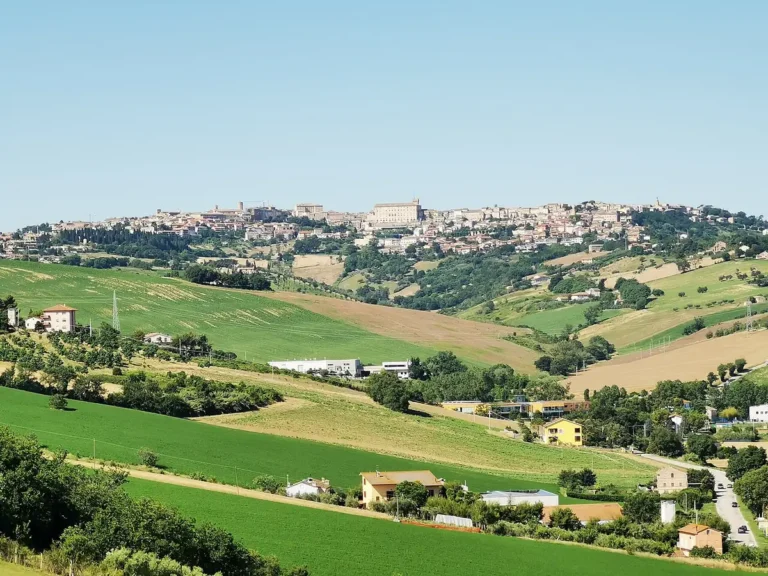
Fabriano lies inland in the province of Ancona, in the Apennine part of Marche, on the railway that crosses the region from the Umbrian border near Fossato di Vico down to the Adriatic coast at Falconara (Regione Marche). It is a working town rather than a postcard village, which is part of its charm: the old center is compact, lived in and rarely crowded.
For us it is close to home. The branch line from Fabriano toward Civitanova Marche runs through Castelraimondo-Camerino, a few minutes from our base, and on to Tolentino and Macerata (Regione Marche). If you are still choosing where to go in the region, our guide to the most beautiful towns in Le Marche puts Fabriano in context.
Is Fabriano worth visiting?
Yes, especially if you like places with a real story and few tourists. Fabriano’s history is inseparable from paper: master papermakers produced some of the world’s finest sheets here, and UNESCO added the town to its Creative Cities network because it turned craft and art into the heart of its economy (Italia.it). Watermarking, the technique of hiding designs in a sheet that only show against the light, was first introduced right here (Visit Fabriano).
Beyond paper, the town has a triangular medieval square with a 13th-century palace and fountain, a cathedral with 14th-century frescoes, a civic art gallery and an oratory known locally as the “Sistine Chapel of the Marche”. Add the Frasassi Caves a short distance away and you have one of the most rewarding inland days in the region.
What to see in Fabriano
The essentials are the Paper and Watermark Museum and Piazza del Comune, which are a short walk apart. With more time, add the Pinacoteca, the Loggiato San Francesco, the cathedral and the Oratorio della Carità.
| Sight | What it is | Time needed | Our tip |
|---|---|---|---|
| Museo della Carta e della Filigrana | Paper and Watermark Museum in a former Dominican convent, with a live hand papermaking demonstration | About 1 hour guided | Book the free guided slot online; call ahead for English |
| Piazza del Comune | Triangular main square with the Palazzo del Podestà (1255) and the Sturinalto fountain (1285) | 30 to 45 minutes | Walk under the great Gothic arch of the palace |
| Loggiato San Francesco | Portico of 19 arches overlooking the square | 15 minutes | Best view of the whole piazza |
| Cattedrale di San Venanzio | Cathedral with a Gothic apse, cloister and Allegretto Nuzi frescoes | 30 minutes | Look for the Chapel of San Lorenzo |
| Pinacoteca Civica Bruno Molajoli | Civic art gallery with 13th and 14th-century frescoes and panel paintings | 45 minutes to 1 hour | Included in the Paper Museum ticket |
| Oratorio della Carità | Oratory with 14 frescoes and a 1595 canvas by Filippo Bellini | 20 to 30 minutes | Open Thursday afternoon to Sunday only |
| Teatro Gentile | Horseshoe-shaped 19th-century theater named after the painter Gentile da Fabriano | 20 minutes | Visits by booking through the tourist office |
The Paper and Watermark Museum
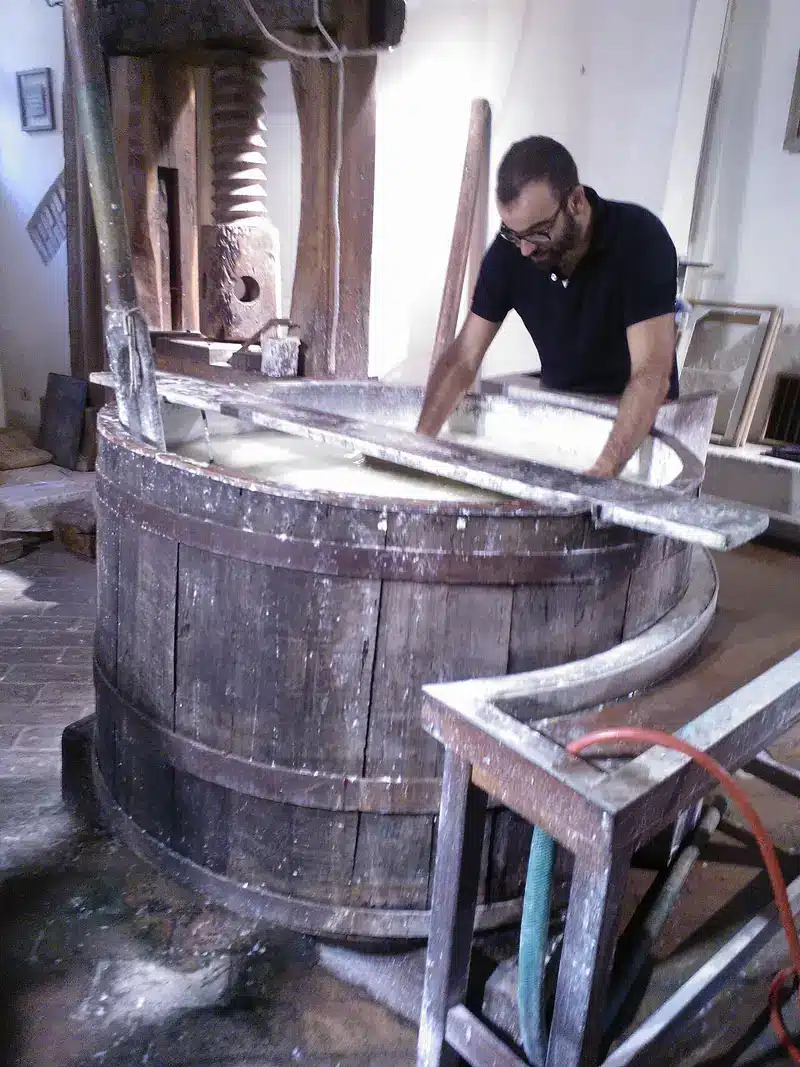
This is the reason most people come. The museum fills the former convent of the Dominican friars and tells seven centuries of local papermaking, with a faithful reproduction of a medieval paper mill (Ministry of Culture). The guided visit lasts about an hour and includes a live demonstration by the museum’s master papermakers, the story of paper and its machinery, and rooms of historic watermarks from the 13th century to today (Museo della Carta).
Italia.it adds the details that delight our guests: looms, fibers and felts, rare banknotes and paper made from unusual raw materials such as artichokes (Italia.it). After the visit you can join a workshop and make your own sheet of paper. And a fresh piece of news: on 4 November 2026 the museum announced that it is now dog-friendly, pointing to one of the loveliest watermarks in the Sala Zonghi, a running dog, among the old Fabriano watermarks from 1293 to 1599 (Museo della Carta).
Piazza del Comune, the Palazzo del Podestà and the Sturinalto fountain
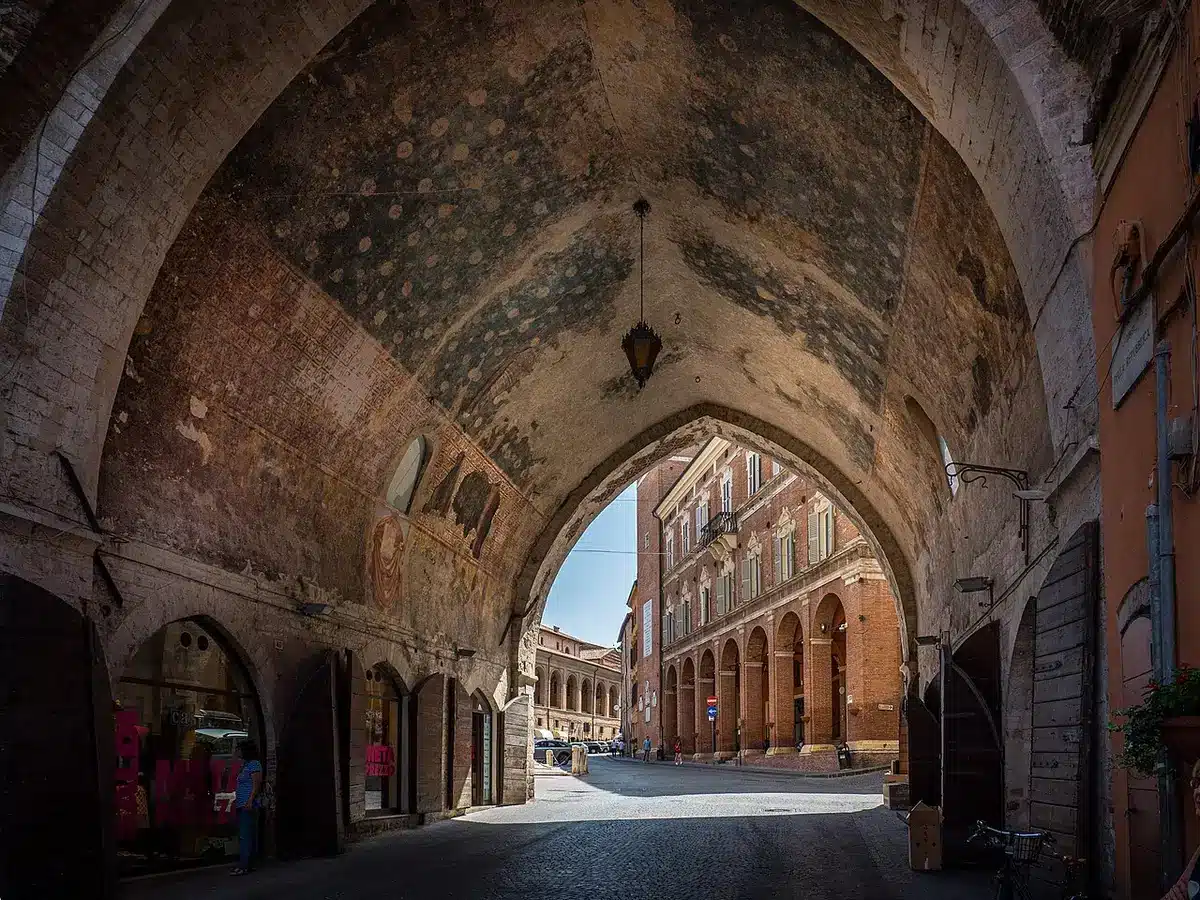
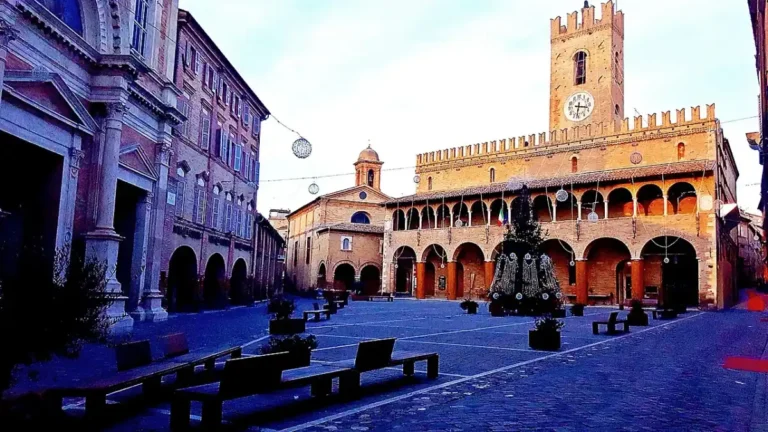
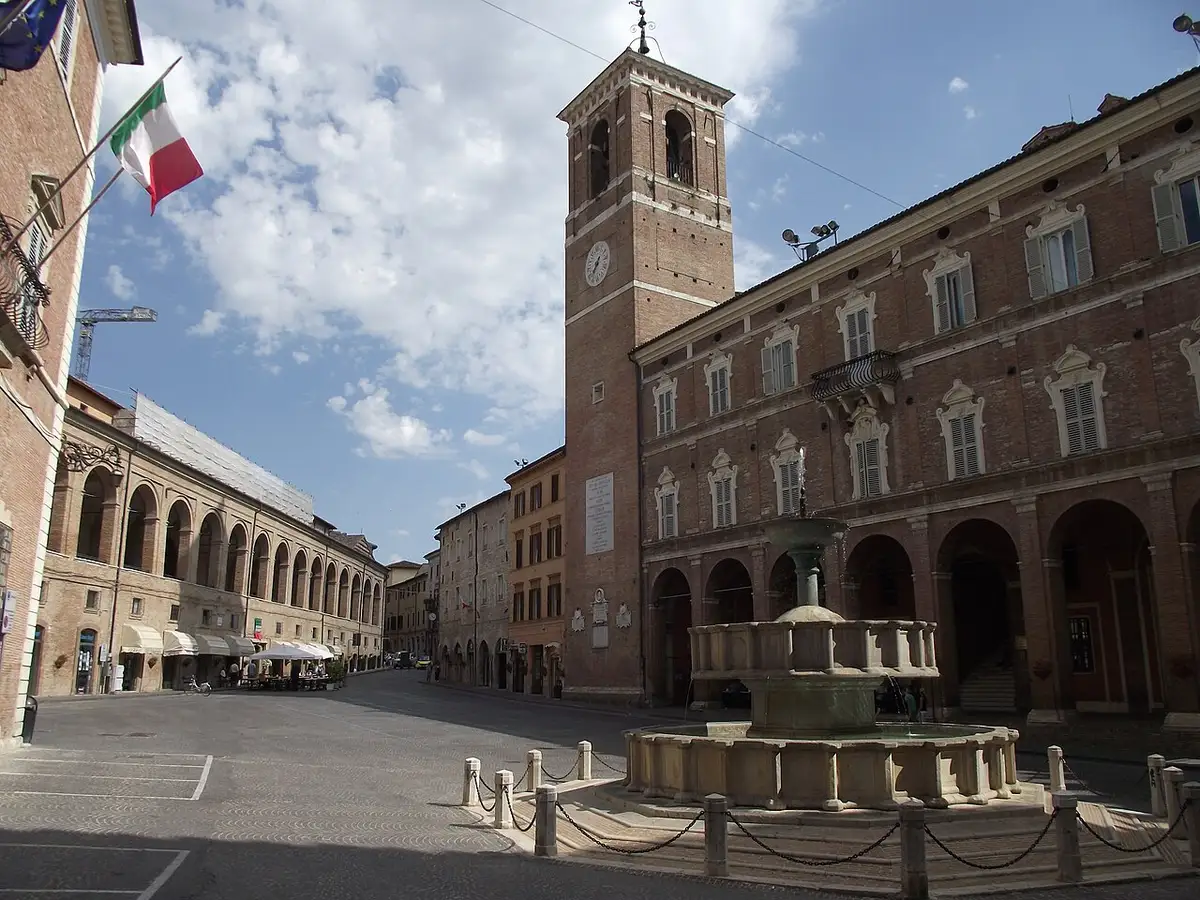
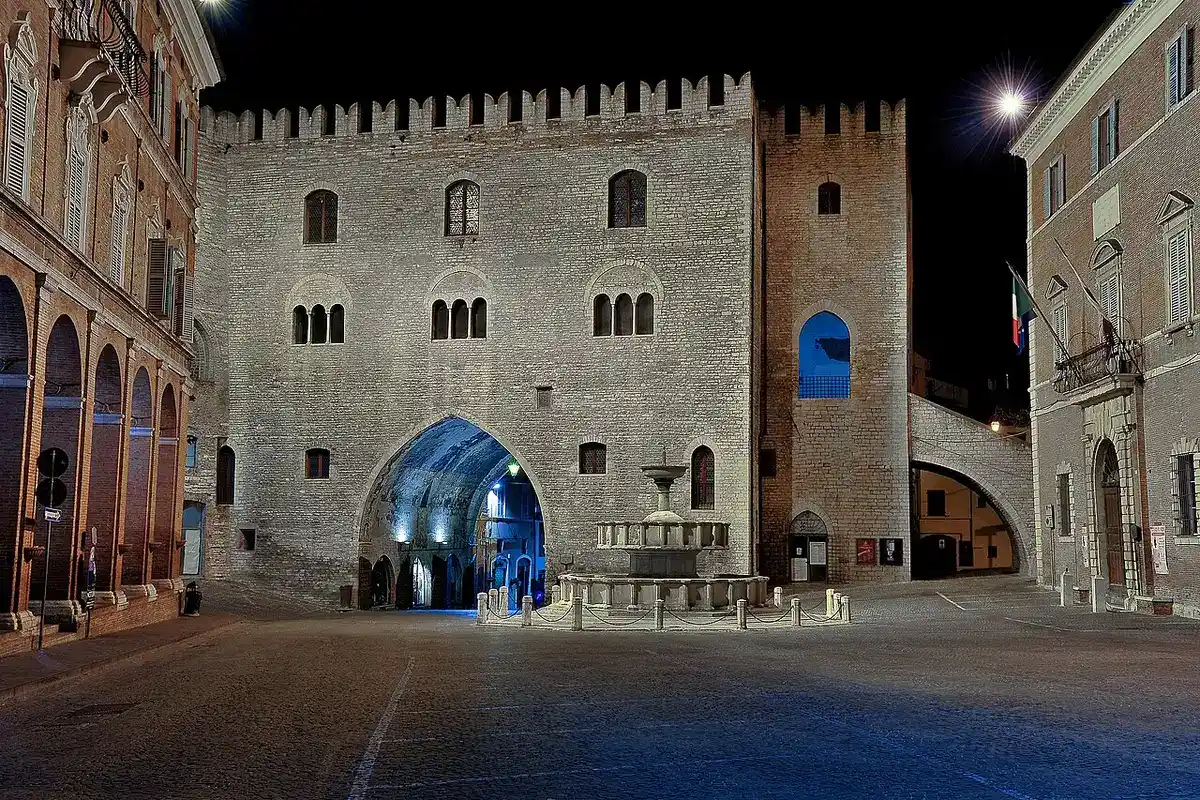
Fabriano’s main square, once called the Platea Magna, has an unusual triangular shape. The Palazzo del Podestà, built in 1255 in white Vallemontagnana stone, stands out against the red brick around it and is one of the finest Gothic buildings in Marche. Its pointed arch is 11.70 meters high, and a branch of the town’s river once ran underneath it; inside the arch look for frescoes by Ventura di Francesco from 1326, including a Wheel of Fortune (Visit Fabriano, Palazzo del Podestà).
In the center, the Sturinalto fountain was built in 1285 by Jacopo di Grondolo on the model of the Pisano fountain in Perugia; one of its panels shows the town’s coat of arms, a blacksmith at work on a bridge (Visit Fabriano). Around the square you also see the Palazzo del Comune, built around 1350 as the residence of the Chiavelli family, lords of the town until 1435, and the Bishop’s Palace with the civic tower (Visit Fabriano).
Loggiato San Francesco and the Cathedral of San Venanzio
The Loggiato San Francesco, a portico of 19 arches, was rebuilt in the 1600s over a 15th-century portico that Vasari attributed to Bernardo Rossellino, at the wish of Pope Nicholas V. Walking along it gives you the best view of the square, and the wall keeps the only remains of the 14th-century church of San Francesco (Visit Fabriano).
The Cathedral of San Venanzio, first recorded in 1047, was rebuilt in Baroque style in the 17th century to a design by Muzio Oddi of Urbino, but its Gothic polygonal apse, cloister and Chapel of San Lorenzo survive. The chapel holds Allegretto Nuzi’s frescoes of the Life of Saint Lawrence (Visit Fabriano).
Pinacoteca Molajoli, the Oratorio della Carità and the Teatro Gentile
The Pinacoteca Civica Bruno Molajoli, in the former hospital of Santa Maria del Buon Gesù, keeps frescoes from the second half of the 13th and the first half of the 14th century (Ministry of Culture). It is the place to understand Fabriano’s school of painting around Allegretto Nuzi (Pinacoteca Molajoli).
The Oratorio della Carità is called the “Sistine Chapel of the Marche” for its 14 frescoes and central canvas by Filippo Bellini of Urbino, dated 1595, and it also houses a 1908 C. Bechstein grand piano (Visit Fabriano). The Museo Guelfo is devoted to the surrealist artist Gaetano Ulisse Bianchini, known as Guelfo (1937 to 1997), whose stained glass Marc Chagall praised (Visit Fabriano). The Teatro Gentile opened in May 1884 with Verdi’s Aida and has 91 boxes on four tiers (Visit Fabriano).
Want to see Fabriano as part of a private Marche trip?
We like to pair Fabriano with the Frasassi Caves: a booked morning with the master papermakers, lunch in town, then the caves in the afternoon, with our own drivers taking you there and back to your hotel. See our private Marche tours to get an idea of how we work.
Fabriano opening hours and tickets in 2026
Most sights are open Tuesday to Sunday and close on Monday, and one ticket covers the two main museums. These are the hours and prices published by the museums as of November 2026.
- Paper and Watermark Museum: Tuesday to Sunday, 9:30 to 13:30 and 15:00 to 18:00, closed Monday. Adults €12, under 18 €5, over 65 €10, family (2 adults and 1 child under 18) €24, papermaking workshop €5. The ticket includes the Pinacoteca. Guided visits are free to book online but places are limited; guides speak Italian, French, English and Spanish, and for a visit in another language you need to book by phone (Museo della Carta)
- Extra openings and closures: the museum opens on 6 January, Easter Sunday and Monday, 25 April, 2 June, 15 August and 1 November, and closes on 1 January and Christmas Day (Museo della Carta)
- Integrated ticket: €14 adds the Oratorio della Carità and the Museo Guelfo (Museo della Carta); if you have a Frasassi Caves ticket, the museum’s partner rate is €10
- Pinacoteca Molajoli: Tuesday to Sunday, 10:00 to 13:00 and 15:00 to 18:00; €7 on its own (Pinacoteca Molajoli)
- Oratorio della Carità: Thursday 15:00 to 18:00, Friday to Sunday 10:00 to 13:00 and 15:00 to 19:00. Museo Guelfo: Friday 15:00 to 19:00, Saturday and Sunday 10:00 to 13:00 and 15:00 to 19:00 (Fabriano civic museums)
- Tourist office (IAT): inside the Palazzo del Podestà, Tuesday to Sunday 10:00 to 13:00 and 15:00 to 18:00 (Visit Fabriano)
How to get to Fabriano
Fabriano is one of the easiest inland towns in Marche to reach by train, because it sits on the main Rome to Ancona line.
- From Rome: direct trains from Roma Termini; in the current timetable, for example, the Frecciargento 8851 leaves Fabriano at 8:37 and reaches Roma Termini at 11:00, and Regionale Veloce trains take about 3 hours (RFI Fabriano timetable, valid to 12 December 2026)
- From Ancona: regional trains via Jesi take about 1 hour 10 to 1 hour 20 minutes; the fastest Intercity takes 54 minutes (RFI Fabriano timetable)
- For the Frasassi Caves: the caves are in the Genga area, and Genga-San Vittore Terme station is the first stop from Fabriano toward Ancona (RFI Ancona timetable)
- Toward Macerata: the Civitanova Marche to Fabriano line links the town with Castelraimondo-Camerino, Tolentino and Macerata; a restored stretch from Fabriano to Pergola runs heritage trains for tourists (Regione Marche)
Trains work well for Fabriano itself, but the countryside around it, from the caves to the mural village of Cacciano, is far easier with a car or a private driver. If you would rather not drive at all, our post on two weeks in Marche without a car shows how we plan it.
How to spend one day in Fabriano
This is the day we would plan for guests arriving on a Friday, Saturday or Sunday, when every site below is open.
- 9:30 Paper and Watermark Museum, guided visit with the master papermakers (about 1 hour), booked online in advance.
- 10:45 Make your own sheet of paper in the museum workshop.
- 11:30 Pinacoteca Molajoli, included in your museum ticket.
- 12:45 Walk up to Piazza del Comune, under the arch of the Palazzo del Podestà and along the Loggiato San Francesco.
- 13:15 Lunch in the center: salame di Fabriano to start, then homemade pasta or vincisgrassi.
- 15:00 Oratorio della Carità and, on the integrated ticket, the Museo Guelfo.
- 16:00 Cathedral of San Venanzio and the Allegretto Nuzi frescoes, then a last coffee in the square. With a driver, you can instead spend the afternoon at the Frasassi Caves.
What to eat in Fabriano
Order the salame di Fabriano. This is a Slow Food presidium, and Italia.it also recommends barrique-aged honey and a glass of mead before you leave (Italia.it).
The salame di Fabriano, also called salame lardellato, is made from the best cuts of pork, such as leg and shoulder, and the town’s tourism site lists ciauscolo as the other great local cured meat. Inland cooking here is all about homemade pasta: cannelloni, cappelletti, tagliatelle and the famous vincisgrassi, plus dishes of chicken or rabbit (Visit Fabriano). For wine, the Verdicchio country around Jesi is on the same railway line, and our food and wine tours can add a winery lunch to the day.
When is the best time to visit Fabriano?
Late spring to early autumn is the easiest time, and June is the most festive month. The museums are open all year from Tuesday to Sunday, so Fabriano also works as an off-season day, as long as you avoid Mondays.
- Palio di San Giovanni Battista (June): the four historic quarters compete in archery and traditional games, more than 500 people parade in 14th-century costume, flower carpets cover the streets and the quarters open their “Hostarie” with local dishes. The festival ends on 24 June, the feast of Saint John the Baptist (Visit Fabriano)
- Primavera Fabrianese (early May): a historic Apennine trail race organized by the local Italian Alpine Club since 1976 (Visit Fabriano)
- FabrianoInAcquarello: an international watercolor event held every year since 2010, with exhibitions, workshops and demonstrations (Visit Fabriano)
- Fabriano Carta è Cultura: an annual festival of music, art, cinema, theater and talks built around paper and the UNESCO Creative Cities network (Visit Fabriano)
What is near Fabriano?
The Frasassi Caves are the obvious pairing, and the mural village of Cacciano is the surprise. Italia.it names both as worth a visit a short distance from Fabriano (Italia.it).
- Frasassi Caves (Genga): one stop down the line by train, and a partner of the Paper Museum for discounted tickets (Museo della Carta)
- Cacciano: a small village of Lombard origin on the slopes of Monte Maggio, its house fronts painted by street artists with wildlife, farm life and the people who live there (Visit Fabriano)
- Sassoferrato: its civic museums have a ticket agreement with the Paper Museum (Museo della Carta)
- Jesi, Camerino and Tolentino: all on the railway from Fabriano; see our guides to Jesi, Camerino and Tolentino
Fabriano, Italy: frequently asked questions
Is Fabriano, Italy worth visiting?
Yes. Fabriano is the city of paper: at the Paper and Watermark Museum you watch master papermakers make sheets by hand, and the triangular Piazza del Comune has a 1255 Gothic palace and a 1285 fountain. Half a day covers the essentials; a full day adds the art gallery, the cathedral and the Oratorio della Carità.
What is Fabriano famous for?
Fabriano is famous for handmade paper and watermarks, a tradition going back to the 13th century. Watermarking was first introduced here, and UNESCO has listed Fabriano as a Creative City for Crafts and Folk Art since 2013.
How much does the Fabriano Paper Museum cost?
An adult ticket costs €12 and includes the Pinacoteca Molajoli art gallery. Under 18s pay €5, over 65s €10, and a family ticket for 2 adults and 1 child under 18 is €24. The integrated €14 ticket adds the Oratorio della Carità and the Museo Guelfo, and the papermaking workshop is €5.
Can you visit the Paper Museum in English?
Yes. The guided visit lasts about an hour and the museum’s guides speak Italian, French, English and Spanish. Booking a guided slot is free online, but for a visit in a specific language the museum asks you to book by phone.
When are the museums in Fabriano closed?
The Paper Museum and the Pinacoteca are open Tuesday to Sunday and closed on Monday. The Paper Museum also closes on 1 January and Christmas Day, and opens on holidays such as Easter Monday, 25 April, 2 June, 15 August and 1 November.
How do you get to Fabriano from Rome?
Take a direct train from Roma Termini on the Rome to Ancona line. The fastest trains take about 2 hours 25 minutes and Regionale Veloce trains about 3 hours, according to the current RFI timetable. From Ancona, direct trains take 54 minutes to about 1 hour 20 minutes.
Is Fabriano near the Frasassi Caves?
Yes. The caves are in the Genga area, a short distance from Fabriano, and Genga-San Vittore Terme station is the first stop from Fabriano toward Ancona. The Paper Museum offers a reduced €10 ticket to Frasassi visitors.
Plan your Fabriano visit with locals
Sweet Life Italy is a certified incoming tour operator of the Marche Region, based in Castelraimondo and founded by Marco and Ilaria, who live in Marche. We design private, tailor-made trips for 1 to 7 guests across Marche and the rest of Italy, with licensed guides, food and wine experiences and our own drivers, and we bring more than 13 years in luxury tourism to every itinerary. Fabriano can be the craft chapter of a private Marche tour or part of one of our private luxury tours of Italy.
Tell us about your trip and we will start with a free video call. After that we send a day-by-day proposal and a free first estimate. Please allow at least 8 weeks before your travel dates.
Featured photo: Piazza del Comune in Fabriano with the Sturinalto fountain, by Parsifall via Wikimedia Commons, CC BY-SA 3.0.