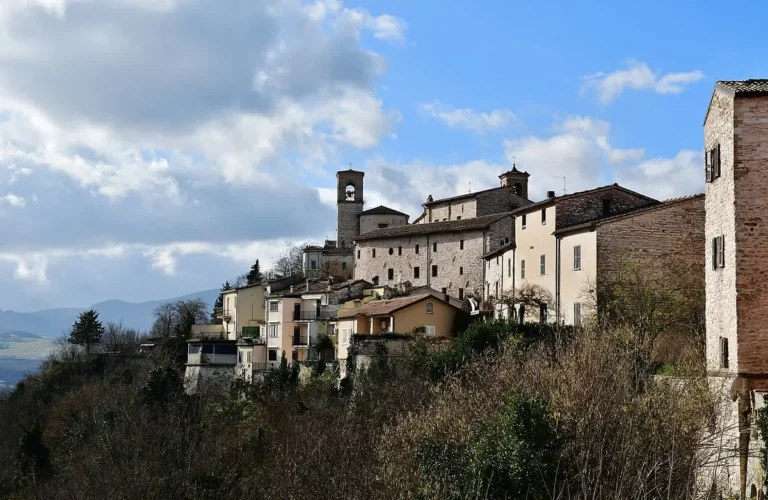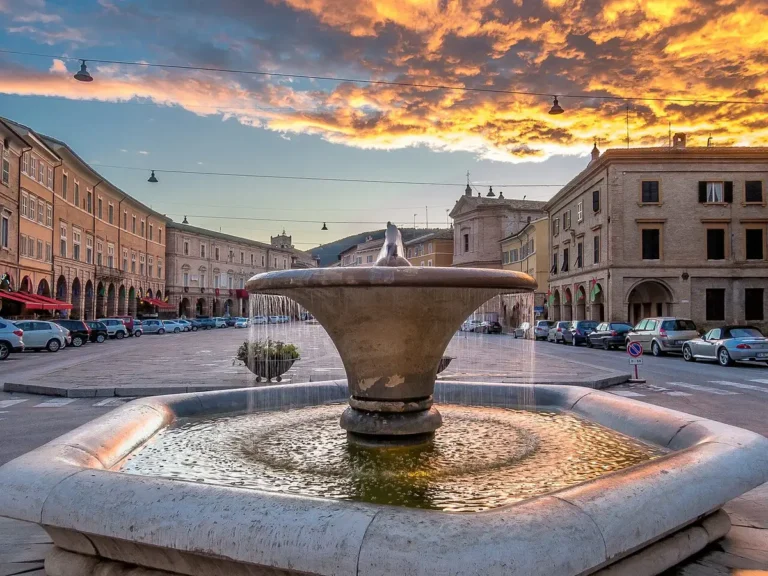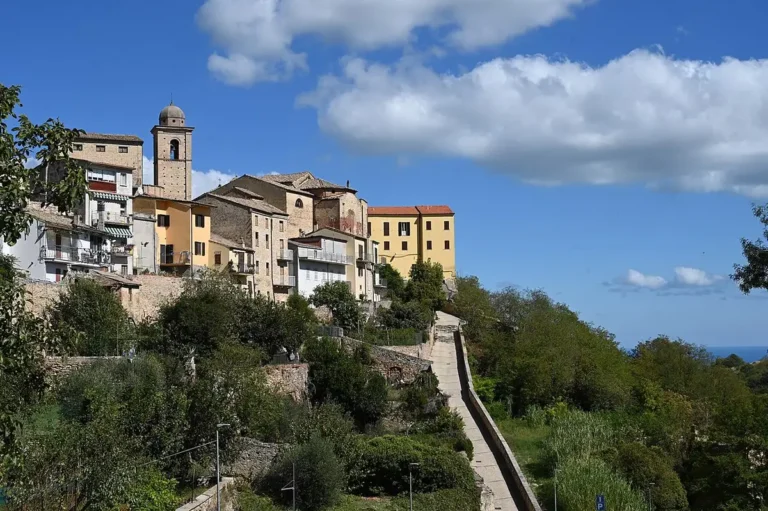
Cingoli is a walled hilltop town in the province of Macerata, in central Marche, Italy, perched at 631 meters on Monte Circe. Known as the Balcony of Marche for its view from the Apennines to the Adriatic, it was voted Italy’s Borgo dei Borghi 2026. Come for the panorama, a Lorenzo Lotto masterpiece and a large lake below town.
Cingoli: key facts
- Region and province: Marche, province of Macerata, 631 m above sea level, one of the Borghi più belli d’Italia and an Orange Flag town of the Touring Club (I Borghi più belli d’Italia, Italia.it)
- Title: winner of Rai 3’s Il Borgo dei Borghi 2026, the TV contest for Italy’s favorite village (Rai)
- From Ancona and Rome: there is no railway station; drive the SS76 Ancona to Rome expressway to the Jesi Ovest exit and follow signs up to Cingoli (e-borghi, Turismo Jesi), or take a train to Jesi and the Crognaletti bus (Pro Loco Cingoli, bus timetables)
- Best for: big views, Renaissance art, Romanesque churches, quiet medieval lanes, lake walks and local food
- How long to spend: half a day for the old town; a full day if you add the lake or the Santa Sperandia hermitage
Cingoli is in our own province: we are based in Castelraimondo, and Sweet Life Italy designs private, tailor-made Marche tours. Below is what we tell friends before their first visit: what to see, which sights open when in 2026, how to get there, what to eat and where Cingoli fits in a wider trip.
Where is Cingoli, Italy?
Cingoli sits on the summit of Monte Circe above the upper Musone valley, in the northern part of the province of Macerata, between the Apennines and the Adriatic coast (Italia.it, the Marche Region’s tourism site). Its almost intact ring of walls encloses a large historic center (Italia.it).
The name comes from the Latin Cingulum, meaning a rocky spur. About 9,600 people live in the municipality, but fewer than a thousand of them inside the old town (I Borghi più belli d’Italia), so the center feels calm, and much of it is closed to traffic.
Why is Cingoli called the Balcony of Marche?
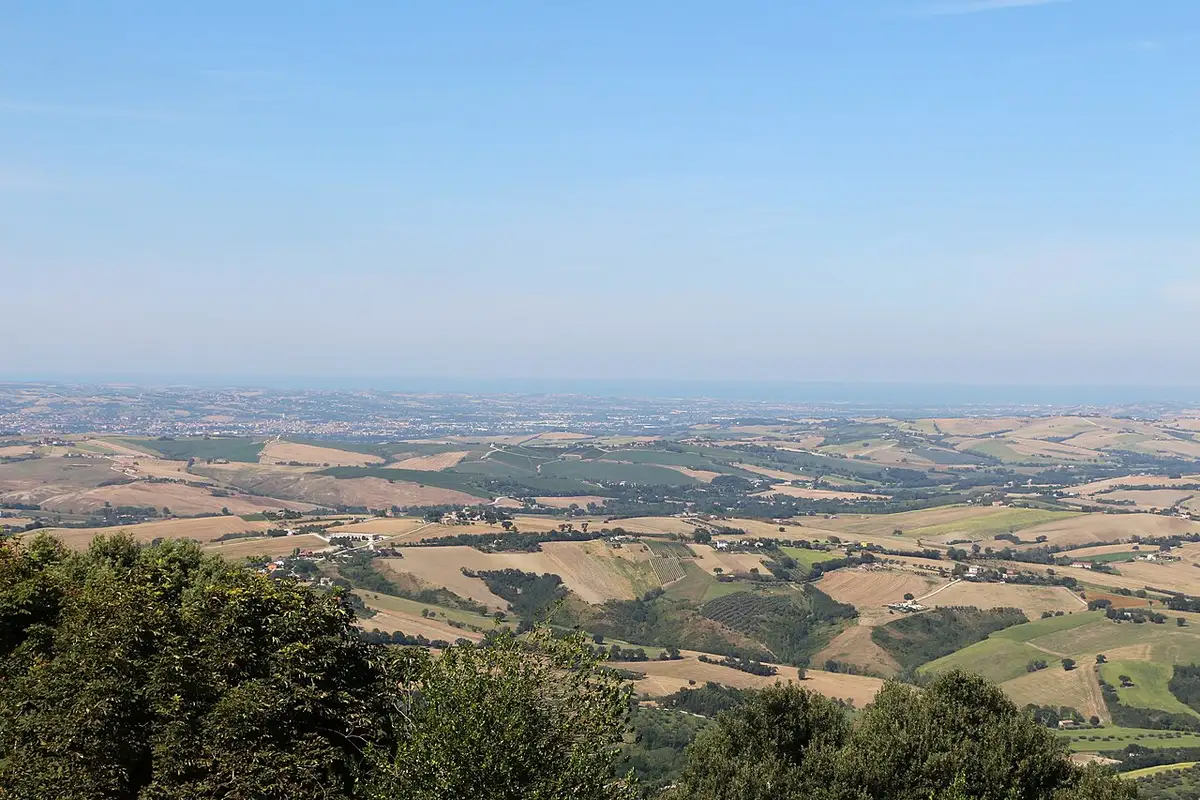
Because of the view. From the large terrace on the medieval walls you look across the Marche hills to the sea and Monte Conero (Italia.it). On a clear day the whole patchwork of fields, villages and ridges is laid out below you.
Go early in the morning or late in the afternoon, when the light is low and the haze is thinner. At 631 meters, summer evenings up here are usually fresher than down on the coast.
Is Cingoli worth visiting?
Yes. In a few hours you can stand on one of the best viewpoints in central Italy, see a major Lorenzo Lotto altarpiece, walk into a 13th-century Romanesque church and finish with lunch in a quiet piazza. Outside August weekends it is usually calm.
The Borgo dei Borghi is a Rai 3 contest with one village per region. In the 13th edition Cingoli came first, ahead of Arenzano in Liguria and Zungoli in Campania (Rai, I Borghi più belli d’Italia).
What to see in Cingoli
The highlights are the Balcone terrace, Lotto’s Madonna del Rosario in the town hall, the Collegiata di Sant’Esuperanzio and the Baroque San Filippo Neri. Hours below are from the official pages we checked in November 2026.
| Sight | What it is | Time needed | Our tip |
|---|---|---|---|
| Balcone delle Marche | Panoramic terrace on the medieval walls | 20 minutes | Best in early morning or late afternoon light |
| Sala degli Stemmi, town hall | Lorenzo Lotto’s Madonna del Rosario (1539) | 30 minutes | €5 ticket also covers the Pinacoteca; booking advised |
| Archaeological museum | Finds from prehistory to Roman times, in the town hall | 45 minutes | Mornings Tue, Wed, Sat, Sun; afternoons Mon, Thu, Fri |
| Collegiata di Sant’Esuperanzio | Romanesque-Gothic church with a portal finished in 1295 | 30 minutes | Free, open 8:00 to 19:30; see the crypt |
| San Filippo Neri | Romanesque facade, lavish Baroque interior | 20 minutes | Free, open 8:00 to 19:30 |
| Palazzo Castiglioni | House museum of Pope Pius VIII | 30 minutes | Booking required through the tourist office |
| Lago di Castreccioni | Large reservoir with trails and summer beaches | 2 hours to half a day | Combine with the adventure park in summer |
Lorenzo Lotto’s Madonna del Rosario
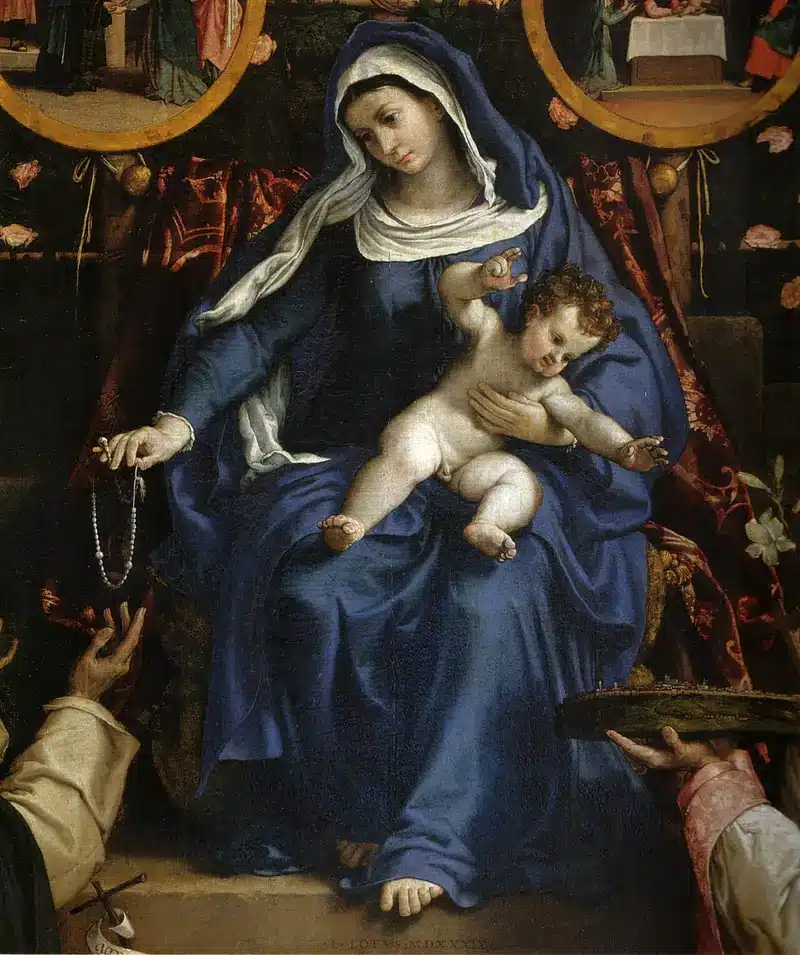
This is the reason art lovers drive up to Cingoli. The Dominicans commissioned the huge canvas (389 by 264 cm) in spring 1537 and Lotto finished it in 1539 (Pro Loco Cingoli). Fifteen small medallions with the Mysteries of the Rosary hang in a rose bush above the Virgin, and Saint Esuperantius, the town’s patron, offers the Christ Child a model of Cingoli painted from life (Città Lottesche museum network).
Many guides, and Google’s own summary, still place it in the church of San Domenico. That church has been closed since the 2016 earthquake, so the painting now hangs in the Sala degli Stemmi of the Palazzo Comunale (Regione Marche, Città Lottesche museum network). Opening hours are Monday to Friday 9:00 to 12:30, plus Tuesday and Thursday 15:00 to 17:45 and Friday 15:00 to 18:00, and weekends and holidays 10:00 to 12:30 and 15:00 to 18:00. A €5 ticket includes the Pinacoteca Donatello Stefanucci, the civic gallery of 20th-century Cingoli artists that reopened in a new layout in 2024. Booking is recommended on +39 0733 602877 (Pro Loco Cingoli).
The archaeological museum
The Museo Archeologico Nazionale, also in the town hall on Piazza Vittorio Emanuele II, tells the story of the area from the Stone Age to the Romans, including a Bronze Age village excavated before the Castreccioni dam flooded the valley. It opens Monday, Thursday and Friday 14:15 to 19:15 and Tuesday, Wednesday, Saturday and Sunday 8:15 to 13:15. Tickets cost €4 (€2 for EU citizens aged 18 to 25, free under 18), and entry is free on the first Sunday of the month (the museum). The museum is fully accessible, with tactile copies and audio guides.
Collegiata di Sant’Esuperanzio
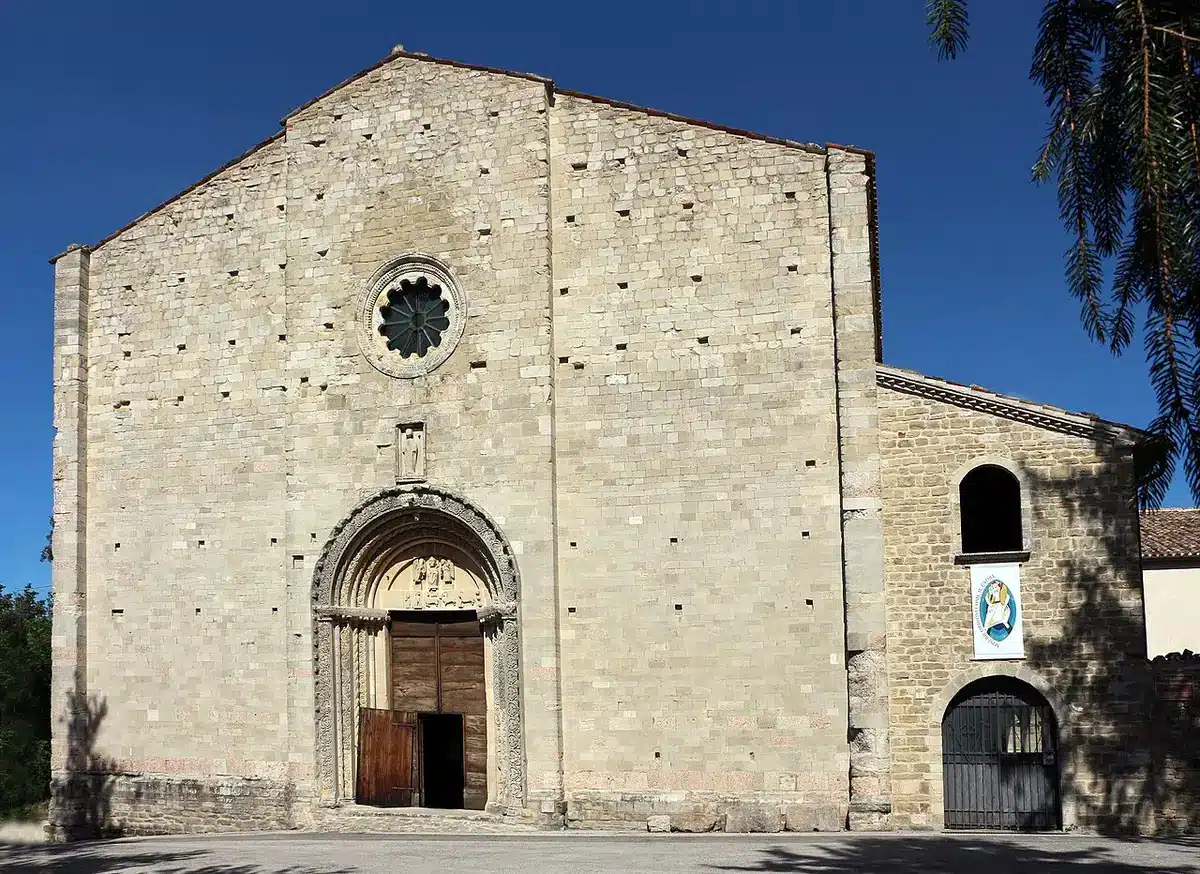
Cingoli’s most important church stands just outside the walls. The present building is 13th century, and its carved portal was finished by a master named Giacomo in 1295, as the Gothic inscription says. Below the presbytery is the crypt with the saint’s relics, found in 1495, and inside is a working 1792 organ by the Venetian builder Callido. It is open daily 8:00 to 19:30, free (Pro Loco Cingoli).
San Filippo Neri, Santa Sperandia and Palazzo Castiglioni
San Filippo Neri hides one of the richest Baroque interiors in Marche behind a 13th-century facade; it was consecrated in 1694, and tradition says Saint Nicholas of Tolentino was ordained a priest here in 1267 (open 8:00 to 19:30, free). The church of Santa Sperandia keeps the body of the Benedictine nun who died in Cingoli in 1276 (open 8:00 to 18:30, free). Palazzo Castiglioni is the house museum of Francesco Saverio Castiglioni, born here in 1761 and elected Pope Pius VIII in 1829; visits are by booking only through the tourist office on +39 0733 602444, €5 (Pro Loco Cingoli).
Between sights, walk Via Foltrani and Via dello Spineto past Renaissance palaces, look into the old Polisena quarter with its steep cobbled lanes, and find the Maltempo fountain on Via Maggiore (I Borghi più belli d’Italia).
Want to see Cingoli as part of a private Marche trip?
We can book the Lotto room and Palazzo Castiglioni ahead, pair your visit with a licensed local guide and a long lunch with Cingoli olive oil, and our own drivers take you between the town, the lake and nearby hill towns. See our private Marche tours.
What is near Cingoli?
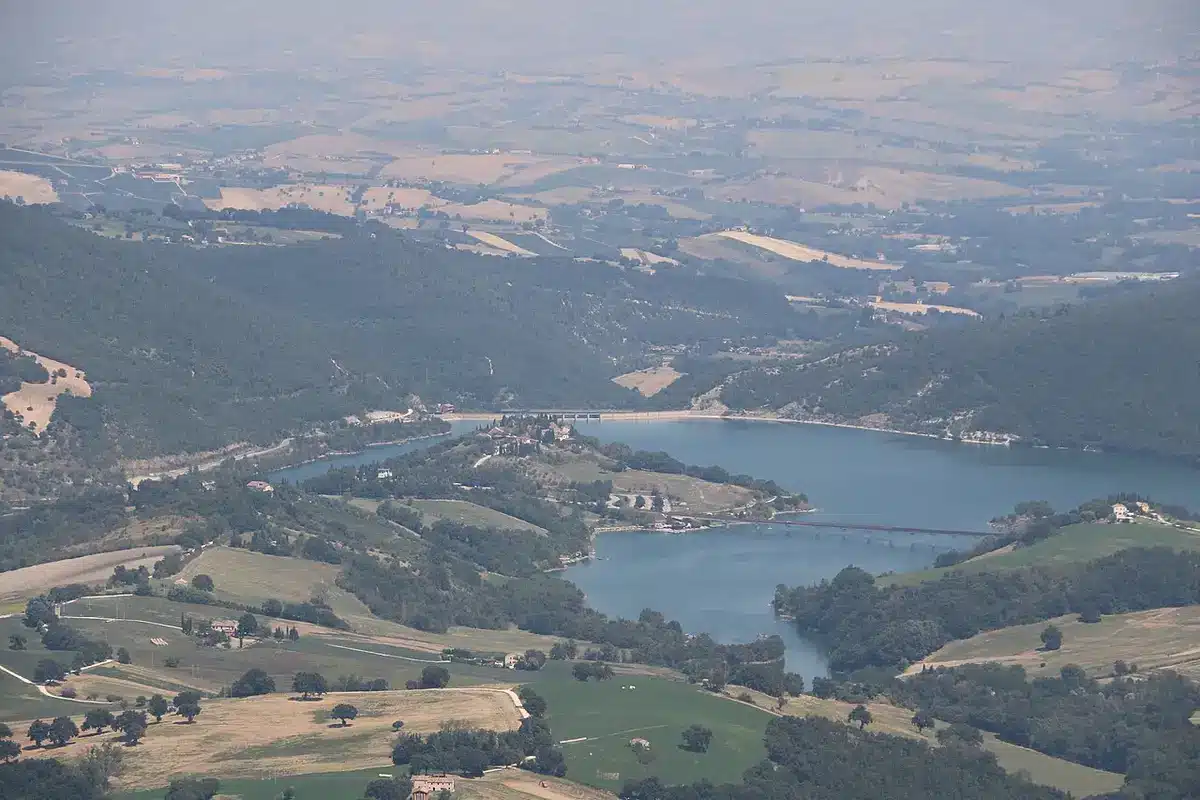
Below town lies Lago di Castreccioni, the largest artificial reservoir in Marche and in all of central Italy. It is a provincial wildlife oasis on the route of migrating water birds, and the woods around it are a protected EU site, with walking and mountain bike trails and a few bars and farm stays on the shore (Turismo Marche). The dam was built between 1981 and 1987, and in summer people sail, pedal-boat, fish and swim here (FAI). Families can add the adventure park below the dam, with five tree-top routes, two of them for children (Turismo Marche). The nearby Museo del Lago is temporarily closed (Pro Loco Cingoli).
About 10 km from town, the hermitage of Santa Sperandia is a set of rock caves on Monte Acuto with a chapel to the saint (Turismo Marche). The regional tourism board also pairs Cingoli with neighboring Apiro in a one-day route (Turismo Marche). Further afield, Cingoli has direct buses to Jesi, the home of Verdicchio, and to San Severino Marche, and in summer to the beach at Porto Recanati (Pro Loco Cingoli, bus timetables), close to Recanati.
How to get to Cingoli
By car is easiest. Cingoli has no train station, so without a car you take a train to Jesi or Macerata and then a local bus.
- By car: from the A14 motorway take the Ancona Nord exit, follow the SS76 expressway toward Rome, leave it at the exit for Cingoli and Jesi Ovest and follow the provincial road up to town (e-borghi). Coming from Rome, the SS76 Ancona to Rome expressway brings you to the same exit (Turismo Jesi).
- By train and bus: Jesi station is on the Ancona to Rome line (Turismo Jesi). From Jesi and from Macerata, Autolinee Crognaletti runs buses to Cingoli, with different timetables when schools are open and closed (Autolinee Crognaletti, Pro Loco Cingoli, bus timetables). Check the PDF timetable before you go.
- By plane: the nearest airport is Ancona Falconara (e-borghi).
- Parking: there is time-limited disc parking near the town hall and museum (the museum).
What to eat in Cingoli
Olive oil first. Cingoli grows the Mignola, an excellent olive variety that gives a very high-quality oil (Italia.it), and the town is a member of the Città dell’Olio network of olive oil towns (Comune di Cingoli). Look for ciauscolo, the soft spreadable salami of the Macerata hills, and for sweets such as the ciambella, the cavalluccio and above all the serpe, a cake shaped like a snake (Italia.it).
Other local dishes are parmigiana di cardi (baked cardoons) and crescia flatbread, and good oil also comes from the hamlet of Troviggiano (I Borghi più belli d’Italia). Ask for the local olive oil at the table: in late autumn, just after the harvest, it is at its most peppery.
When is the best time to visit Cingoli?
Late spring to early autumn, for clear views, long evenings and the lake. Summer brings markets, concerts and Ferragosto a Cingoli on 14 to 16 August; October has I Tesori del Bosco (“treasures of the woods”), and 2 November the Fiera dei Morti fair (Italia.it).
Other fixed dates are the 9 Fossi mountain bike race in April, the “Cingoli 1848” historical reenactment and a national dog show in July, and Tuesday evening craft and antiques markets in July and August (the Marche Region’s tourism site). Right now, until 20 November 2026, the town is marking 200 years since the birth of Carlo Collodi, the author of Pinocchio, with a program of events (Comune di Cingoli). Winter is quiet and can be cold up here, but crisp days give the sharpest views.
One day in Cingoli: our plan
- 9:30 Coffee in Piazza Vittorio Emanuele II, then the Sala degli Stemmi for Lotto’s Madonna del Rosario (booked ahead).
- 10:30 The archaeological museum downstairs on a morning opening day, or the Pinacoteca on the same ticket as Lotto.
- 11:30 Walk Via Foltrani, Via del Podestà and San Filippo Neri, then out to the Collegiata di Sant’Esuperanzio.
- 13:00 Lunch with local olive oil, ciauscolo and, in season, parmigiana di cardi.
- 15:00 Drive down to Lago di Castreccioni for a lakeside walk, or to the Santa Sperandia hermitage on Monte Acuto.
- 18:00 Back on the Balcone delle Marche terrace for the evening light over the hills.
Staying longer in the region? Our guides to the most beautiful towns in Marche and how many days to spend in Marche will help you place Cingoli in a wider itinerary.
Cingoli FAQ
Is Cingoli, Italy worth visiting?
Yes. Cingoli has one of the best viewpoints in central Italy, a major Lorenzo Lotto altarpiece, a 13th-century Romanesque church and a quiet walled old town, and in 2026 it was voted Borgo dei Borghi on Rai 3. Half a day covers the center; a full day adds the lake.
Where is Cingoli?
Cingoli is in the province of Macerata in central Marche, Italy, on the summit of Monte Circe at 631 meters, between the Apennines and the Adriatic. Jesi and Macerata are the nearest towns with train stations.
Why is Cingoli called the Balcony of Marche?
Because of its panoramic position: from the terrace on the medieval walls you can see across the Marche hills to the Adriatic Sea and Monte Conero.
Where is the Lotto painting in Cingoli?
Lorenzo Lotto’s Madonna del Rosario (1539) hangs in the Sala degli Stemmi of the town hall, because the church of San Domenico has been closed since the 2016 earthquake. A €5 ticket also includes the civic Pinacoteca; booking is advised on +39 0733 602877.
Which village won Borgo dei Borghi 2026?
Cingoli, in the province of Macerata, won the 13th edition of Il Borgo dei Borghi on Rai 3 in April 2026, ahead of Arenzano (Liguria) and Zungoli (Campania).
How do I get to Cingoli without a car?
Take a train to Jesi, on the Ancona to Rome line, or to Macerata, then an Autolinee Crognaletti bus to Cingoli. Timetables change between school and holiday periods, so check before you travel.
Can you swim in Lago di Cingoli?
Yes, in summer people swim, sail and use pedal boats on Lago di Castreccioni, the reservoir below Cingoli, which also has walking trails, beaches with umbrellas and an adventure park below the dam.
Plan your Cingoli visit with locals
Sweet Life Italy is a certified incoming tour operator of the Marche Region, based in Castelraimondo and founded by Marco and Ilaria, who live in Marche. We design private, tailor-made trips for 1 to 7 guests across Marche and the rest of Italy, with licensed guides, food and wine experiences and our own drivers, and we bring more than 13 years in luxury tourism to every itinerary. Cingoli can be the panoramic, art-filled chapter of a private Marche tour or part of one of our private luxury tours of Italy.
Tell us about your trip and we will start with a free video call. After that we send a day-by-day proposal and a free first estimate. Please allow at least 8 weeks before your travel dates.
Featured photo: the view from the Balcone delle Marche in Cingoli, by Sailko via Wikimedia Commons, CC BY 3.0.