In Italy, the Befana is a kind old woman on a broomstick who fills children’s stockings with sweets, or coal, on the night of 5 January, the eve of the Epiphany. In 2027 that night falls on Tuesday 5 January, and 6 January is a national holiday. The biggest celebration is the Befana festival in Urbania, in Marche.
Befana in Italy 2027: quick answers
- Who she is: La Befana, an old woman who flies on a broomstick and brings gifts to children on Epiphany Eve.
- When: the night between 5 and 6 January. In 2027 that is Tuesday night into Wednesday 6 January.
- Public holiday: yes, 6 January is a national holiday in Italy.
- Biggest festival: Urbania (Marche), 5 and 6 January 2027, the 30th edition. Day ticket €8, free for children up to 10.
- Rome: the Befana fair in Piazza Navona runs from 1 December 2026 to 6 January 2027.
- Venice: the Regata delle Befane, a rowing race in costume on the Grand Canal, every 6 January.
- What children leave out: a stocking, plus a tangerine or orange and a glass of wine for the Befana.
We are Marco and Ilaria, and we live in Marche, the region Urbania belongs to. We design private, tailor-made trips around Italy, and the Befana is one of the best reasons to stay on after New Year. Every 2027 date and price below comes from the organizers’ own pages, checked on 16 November 2026.
Who is La Befana in Italy?
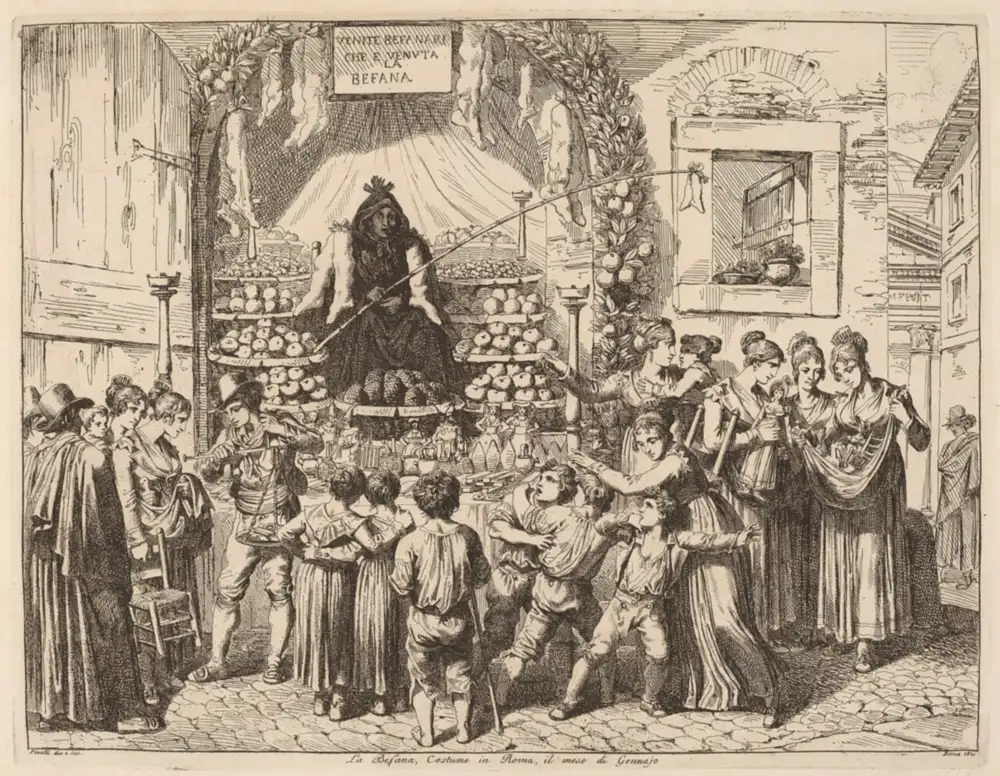
La Befana is a figure of Italian folklore: an old woman with a long nose, a dark shawl and a patched skirt who rides a broomstick and visits every house on the night before the Epiphany. She leaves sweets and small gifts for good children and a lump of coal for the naughty ones.
Her name comes from the Greek word for the Epiphany, which means “apparition” or “manifestation”, as both Italia.it and the Urbania festival explain. Her roots are older than Christianity. According to Italia.it, during the twelve nights after the winter solstice the Romans believed that female figures flew over the fields to bless the next harvest. Christian symbolism then linked her to the Magi, who brought gifts to the infant Jesus.
The version every Italian child hears goes like this: the Three Wise Men stopped at the Befana’s house to ask the way to Bethlehem and invited her to come along. She was too busy sweeping and said no. She changed her mind too late, and ever since she flies from house to house leaving gifts for every child, just in case. That is why she always carries a broom.
When is the Befana celebrated in 2027?
The Befana arrives on the night between 5 and 6 January. In 2027 that is the night of Tuesday 5 January, and the Epiphany itself is Wednesday 6 January.
For Italians the date also has a practical meaning. There is a saying, “L’Epifania tutte le feste porta via”, which Italia.it translates as “Epiphany takes all holidays away”: the Befana closes the Christmas season. Nativity scenes and trees come down soon after, and children go back to school. If you plan a winter trip, this makes 1 to 6 January a festive week with a clear end.
Is 6 January a holiday in Italy?
Yes. The Epiphany, 6 January, is a national public holiday in Italy, so in 2027 Wednesday 6 January is a day off for schools and most offices.
It was not always so. In 1977 Italy removed the Epiphany and four other religious feasts from the civil calendar, judging them bad for productivity, as a Senate bill report recalls. The holiday came back with Presidential Decree no. 792 of 28 December 1985, under the agreement between Italy and the Holy See. So 2026 marked 40 years since the Befana got her day off back.
What do Italian children leave out for La Befana?
Children hang a stocking and leave the Befana a tangerine or an orange and a glass of wine on a plate. In the morning they find the stocking full, the food gone and, as the Urbania festival tells it, her handprint in the ashes on the plate.
Every Italian knows the nursery rhyme: “La Befana vien di notte, con le scarpe tutte rotte, col cappello alla romana, viva viva la Befana!” In English: the Befana comes at night, with her shoes all worn out, wearing a Roman-style hat, long live the Befana! This is how the night usually goes in an Italian home:
- 5 January, evening: children hang a stocking, traditionally on the fireplace, or wherever the family has room.
- The snack: they leave a tangerine or an orange and a glass of wine for the Befana on a plate.
- Bedtime: children go to sleep early, because the Befana does not visit while they are awake.
- The night: she comes down the chimney and fills the stocking with sweets, chocolates and small toys, with a little coal at the bottom.
- 6 January, morning: the stocking is full, the plate is empty, and the Christmas holidays are over.
Where can you see the Befana in Italy in 2027?
The best places are Urbania in Marche, which calls itself the Befana’s home town, Piazza Navona in Rome and the Grand Canal in Venice. Here is what each one offers, with what is already confirmed for 2027.
| Place | Region | What happens | 2027 dates |
|---|---|---|---|
| Urbania | Marche | National Befana Festival: shows, the Befana’s House, sweets thrown to the crowd | 5 and 6 January (30th edition), official site |
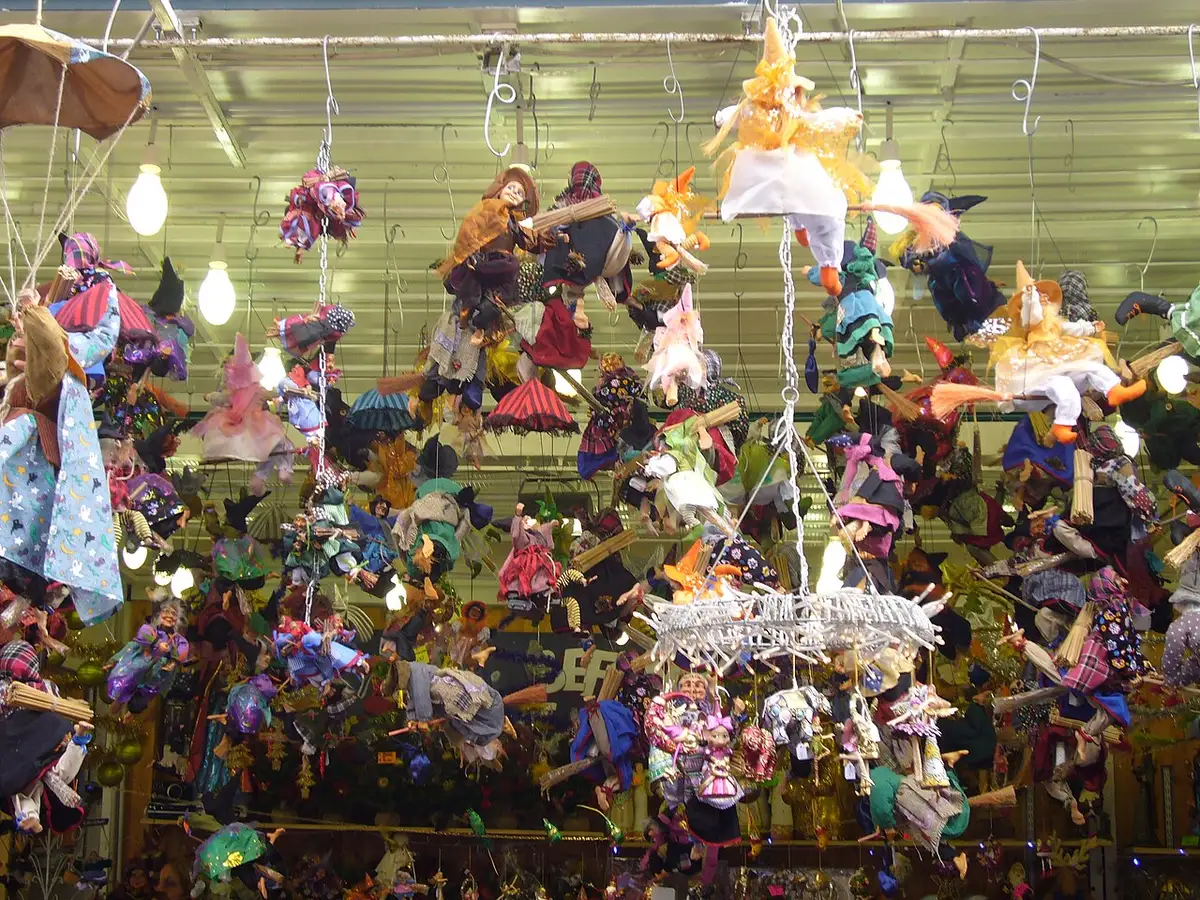
| Rome, Piazza Navona | Lazio | Befana fair with stalls, activities for children and families | 1 December 2026 to 6 January 2027, Roma Capitale notice |
| Rome, Parco degli Acquedotti | Lazio | Corri per la Befana, a 10 km race | Traditionally 6 January, Italia.it |
| Venice, Grand Canal | Veneto | Regata delle Befane, rowers in Befana costume | Every 6 January, club rules |
| Verona | Veneto | Rogo della vecia, a big puppet of the old woman is burned | At Epiphany, Italia.it |
| Cervia, Marina di Pisa and other seaside towns | Emilia-Romagna, Tuscany | Befana dive, a group swim in the sea open to all | Traditionally 6 January, Italia.it |
Why is Urbania the Befana’s town?
Because Urbania, a hill town in the province of Pesaro and Urbino, has hosted the National Befana Festival for almost 30 years, and since 2016 it has her official house. In 2027 the festival reaches its 30th edition on 5 and 6 January, filling the whole historic center.
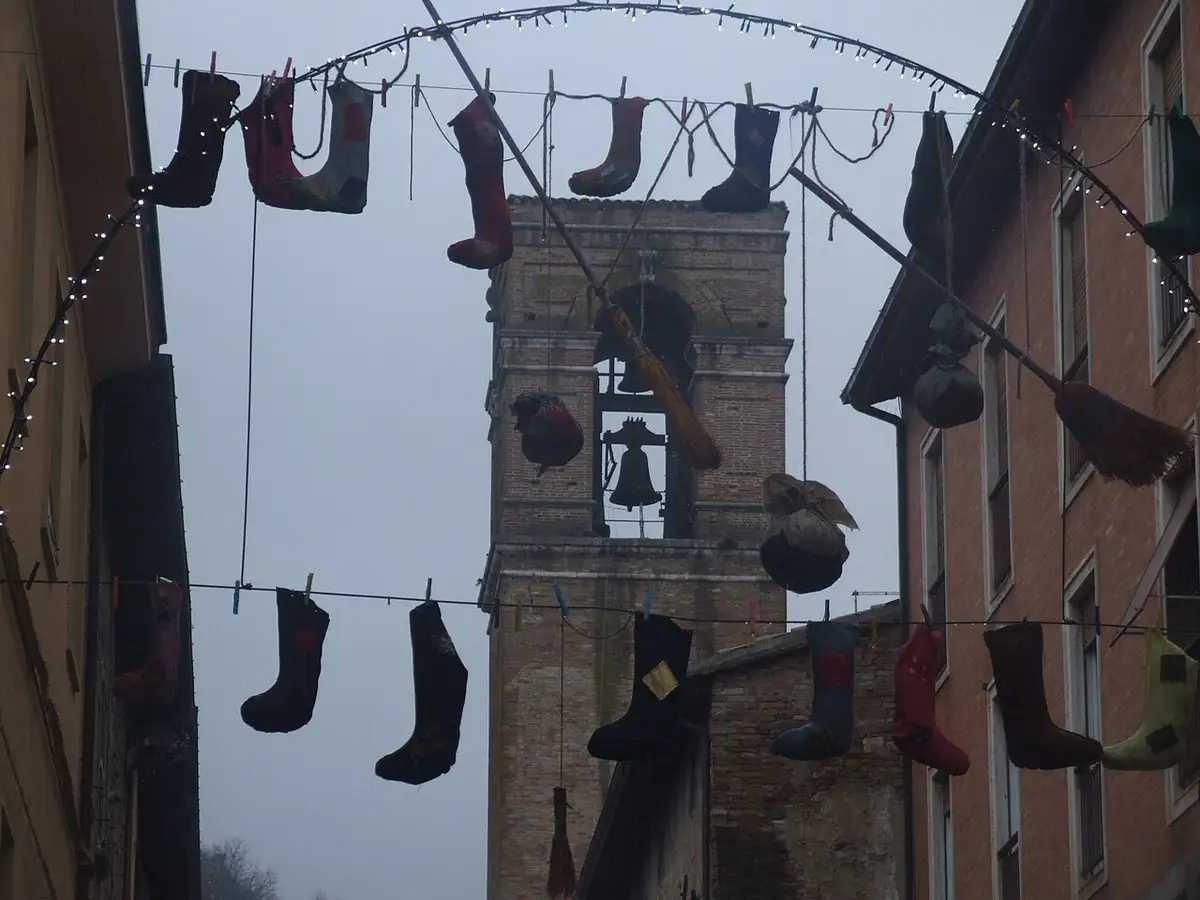
Italia.it describes a town turned into a toyland: 4,000 stockings hung everywhere, a stocking 70 meters long paraded through the streets, 420 kilograms of sweets and around 30,000 visitors a year. The highlight is the Befana coming down from the bell tower, a 36-meter descent, while sweets rain on the crowd. In the 2026 program she came down twice a day, at 4 pm and 6:30 pm, with a video mapping show on the tower.
Tickets. According to the festival’s ticket page, entry is free for children up to 10 and for residents, €8 for one day and €12 for two days, and €5 per person for groups of 20 or more. The ticket includes shows, workshops, sweets and the Befana’s House, but not the museums of the Ducal Palace, the Church of the Dead or the Leonardi Museum. Gates open at 10 am, and you can buy online.
The Befana’s House. The Casa della Befana is a small house in the historic center, designed by the film and TV set designer Egidio Spugnini. Inside, the Befana shows children how she makes her coal and weaves at the loom, and tells stories. During the festival there is also a Befana Post Office where children leave their letters.
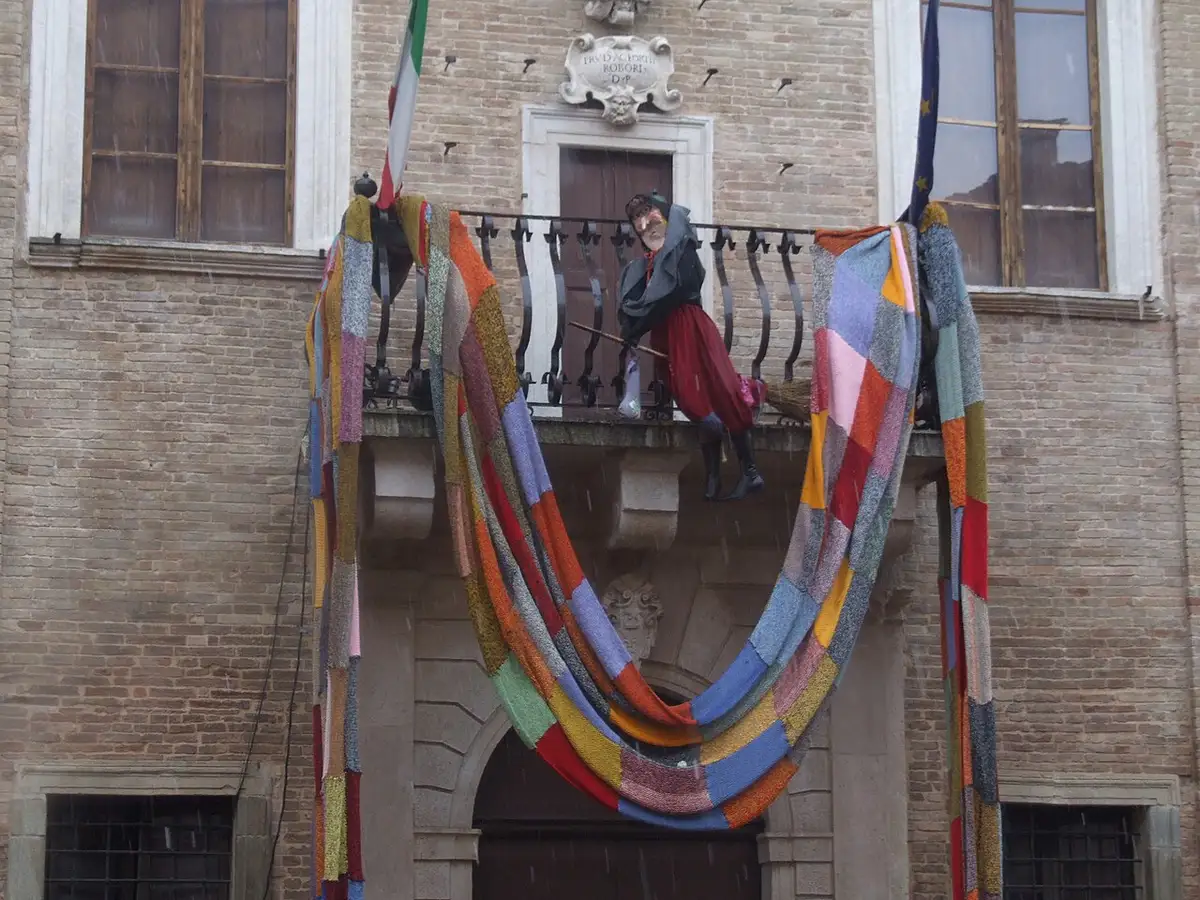
Food. The festival’s Piazza del Gusto, in Piazza del Mercato, has a truffle menu cooked by the Pro Loco of nearby Acqualagna, a town famous for truffles, plus local street food. Italia.it also points to the Crostolo di Urbania, the local flatbread. If truffles are part of your dream trip, read our guide to truffle hunting in Italy.
Getting there. Urbania has no train station. Italia.it suggests a train to Pesaro or Fano and then a direct bus, about an hour and a half. By car, the festival recommends the A14 exit at Fano, then the road toward Urbino. The festival’s directions take you past Urbino, so the two pair naturally: see our guide to Urbino for the Renaissance side of the trip.
The Befana with locals, without the logistics. We plan private trips for 1 to 7 guests: New Year in an Umbrian or Marche hill town, the Befana in Urbania with the best viewpoint for her descent, a truffle lunch in Acqualagna and an afternoon in Urbino, with our own drivers taking you there and back. See our private Marche tours.
How does Rome celebrate the Befana?
Rome celebrates with the Befana fair in Piazza Navona, which in 2026 to 2027 runs from 1 December to 6 January, according to a public notice from Roma Capitale.
The fair fills the Baroque square with stalls, and the city also sets up activities for children and families. On 6 January Italia.it mentions a costume parade in Piazza Navona and the Corri per la Befana, a 10 km race in the Parco degli Acquedotti. The square gets very crowded in the last days, so go on a weekday morning in December if you want to browse the stalls in peace. Our guide to Italy in December covers the other Christmas markets.
What is the Regata delle Befane in Venice?
It is a rowing race on the Grand Canal held every 6 January, in which rowers dressed as the Befana race each other. For the club that runs it, it is the first race of the year.
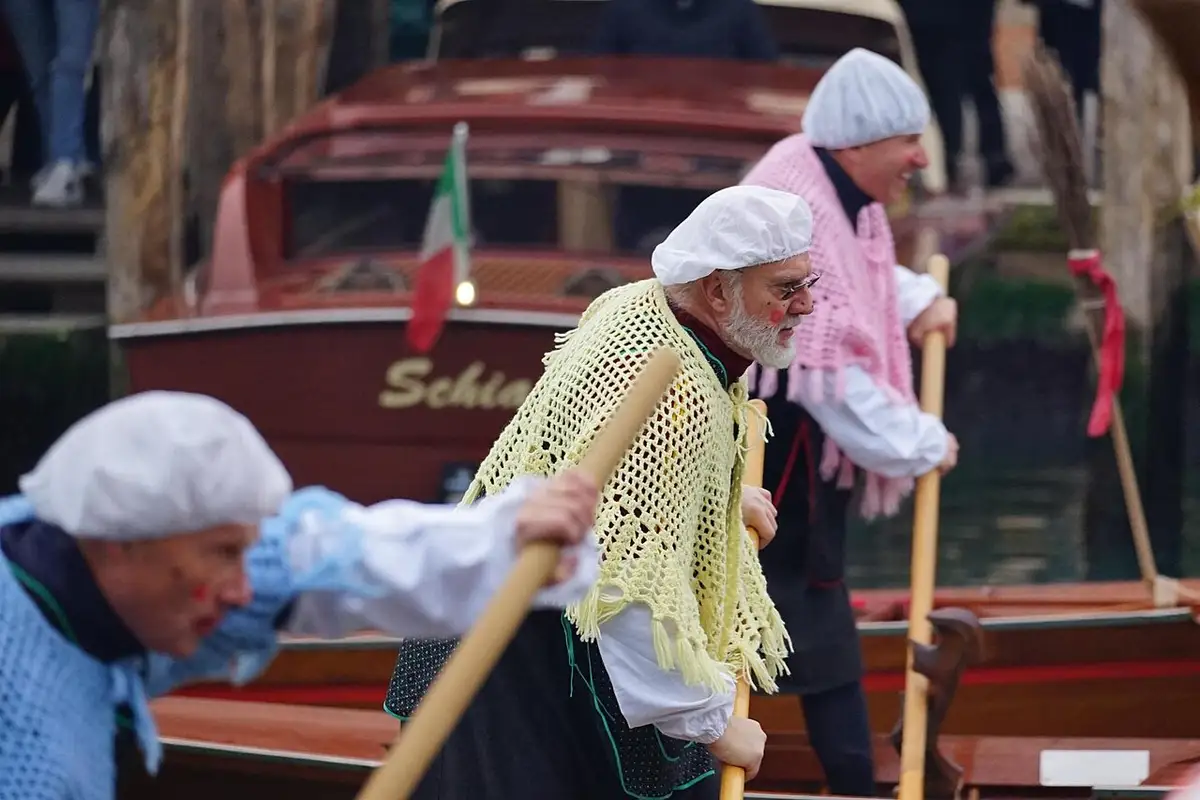
The organizer is the Reale Società Canottieri Bucintoro, one of Venice’s historic rowing clubs. Its rules say the race is rowed in the club’s mascarete, light Venetian boats drawn by lot, with no more than five boats, and that it should keep the playful spirit of a friendly contest between the club’s senior members. The race itself is short, so arrive early for a spot near the Rialto Bridge and check the weather: it is an outdoor event in midwinter.
What do Italians eat at the Epiphany?
Every region has its own Epiphany sweets, and many are only made at this time of year. These are the ones Italia.it lists:
- Fugassa della Befana (Piedmont): a sweet focaccia with candied fruit and sugar grains.
- Befanini (Tuscany): rum-flavored cookies.
- Pepatelli (Abruzzo): cookies with almonds, honey and a pinch of pepper, eaten all through the Christmas season.
- Purcidduzzi (Salento, Puglia): small fried dough balls.
Abruzzo borders Marche to the south, so on a trip that crosses both regions you can taste pepatelli on one side and Urbania’s crostolo on the other.
How to plan a trip around the Befana
The simplest plan is to spend New Year and the Epiphany in one region. Celebrate on 31 December (our guide to New Year’s Eve in Italy lists the big events), slow down on 1 January, and finish in Urbania on 5 or 6 January. In 2027 the Epiphany falls on a Wednesday, so 4 and 5 January are ordinary working days, and Urbania’s first festival day, 5 January, is not a public holiday.
Pack for cold weather, especially inland: Urbania sits in the hills, and the Befana’s descent happens outdoors, late in the afternoon. For the weather, what is open and what to do after the holidays, read our guide to Italy in January, and if you stay into February, our Carnival guide picks up where the Befana leaves off.
Befana Italy: frequently asked questions
Who is La Befana?
La Befana is a kind old woman of Italian folklore who flies on a broomstick on the night between 5 and 6 January and fills children’s stockings with sweets, or coal for the naughty ones. Her story mixes pre-Christian winter rites with the Magi bringing gifts to the infant Jesus.
What does Befana mean in English?
The name comes from the Greek word for the Epiphany, which means apparition or manifestation. In English she is often called the Christmas witch, but in Italy she is seen as a kind grandmother figure.
Is 6 January a holiday in Italy?
Yes. The Epiphany is a national public holiday. It was removed from the civil calendar in 1977 and restored by Presidential Decree no. 792 of 1985. In 2027 it falls on a Wednesday.
What do you leave out for La Befana?
Italian children hang a stocking and leave the Befana a tangerine or an orange and a glass of wine on a plate. In the morning the stocking is full and the plate is empty.
Where is the biggest Befana festival in Italy?
In Urbania, in Marche, where the National Befana Festival reaches its 30th edition on 5 and 6 January 2027. Entry is €8 for one day and free for children up to 10, and the town has the Befana’s House.
Do Italians still celebrate the Befana?
Yes, in every region. Families fill stockings on 5 January, Rome holds the Befana fair in Piazza Navona from 1 December 2026 to 6 January 2027, Venice rows the Regata delle Befane and Urbania hosts a two-day festival.
Plan your Befana trip with locals
Sweet Life Italy is a certified incoming tour operator of the Marche Region, based in Castelraimondo and founded by Marco and Ilaria, who live in Marche. We design private, tailor-made trips for 1 to 7 guests across Marche and the rest of Italy, and we bring more than 13 years in luxury tourism to every itinerary.
We plan every trip with at least 8 weeks’ notice, so if you want to see the Befana in January 2027, now is the moment. Tell us about your trip and we will start with a free video call. After that we send a day-by-day proposal and a free first estimate.
Featured photo: Befana dolls at a stall in Piazza Navona, Rome, by Lalupa via Wikimedia Commons, CC BY-SA 3.0.