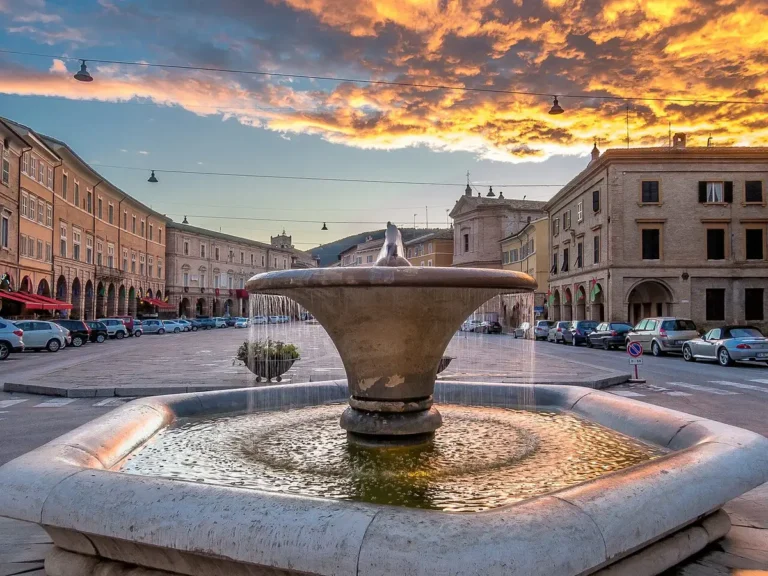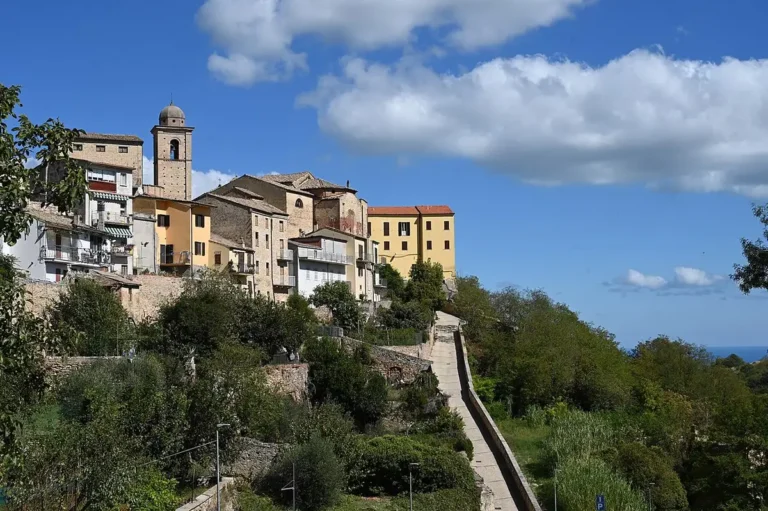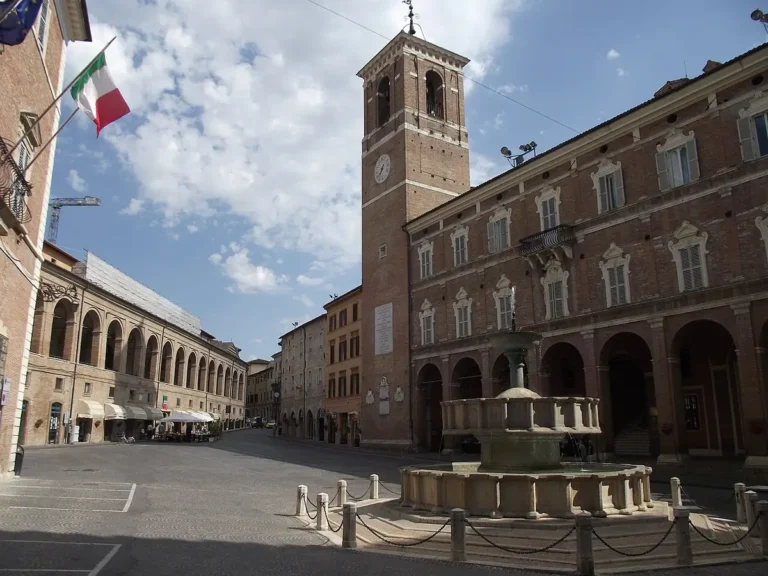

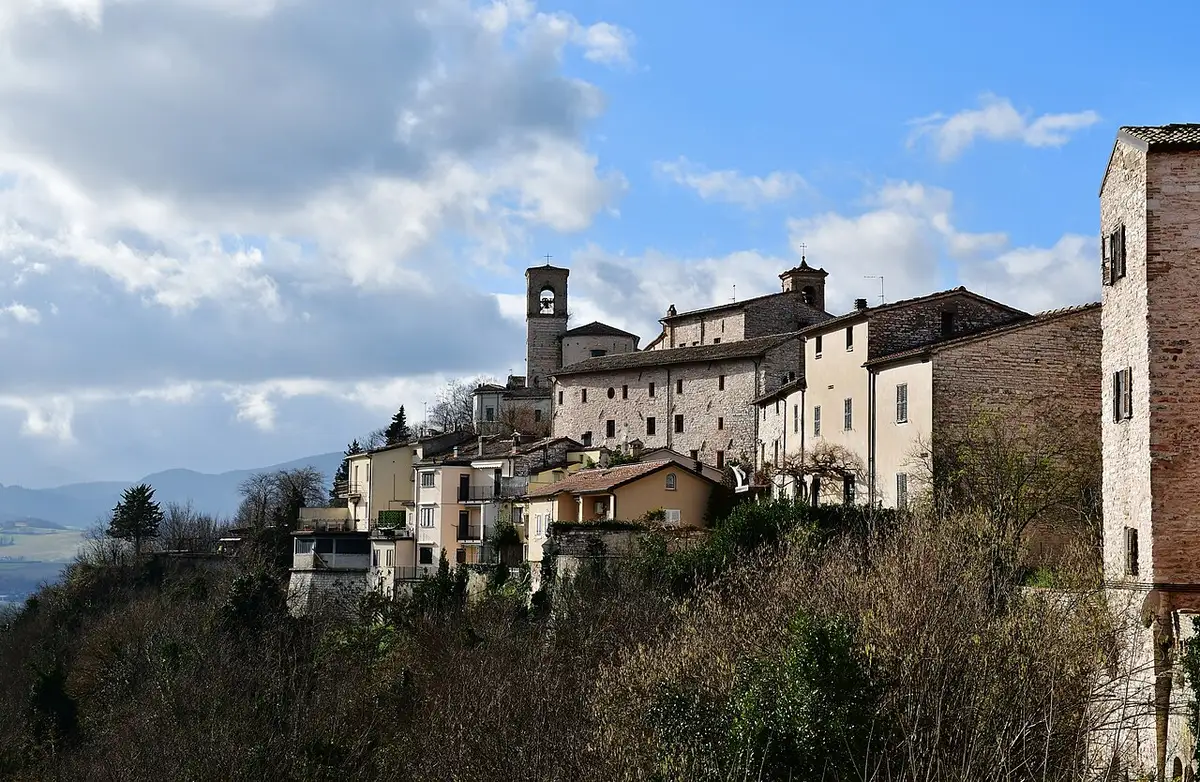
Sassoferrato is a small hill town in the province of Ancona, in inland Marche, Italy. It has two levels, the lower Borgo and the upper Castello under a 1365 fortress, beside Sentinum, the Roman town of the 295 BC Battle of the Nations. Come for Roman ruins, Renaissance art, a sulphur-mining past and very few crowds.
Sassoferrato: key facts
- Region and province: Marche, province of Ancona, at 386 m above sea level, one of the Borghi più belli d’Italia (I Borghi più belli d’Italia)
- From Ancona: just over an hour by car on the SS76 (Italia.it)
- From Rome: about 2 hours 25 minutes by Frecciargento to Fabriano (train 8851 runs Fabriano 8:37 to Roma Termini 11:00), then a 20-minute drive or the ATMA bus (RFI, Fabriano departures)
- Best for: Roman archaeology, medieval fortresses, Renaissance and Baroque painting, industrial heritage and quiet mountain scenery
- How long to spend: one full day for the town, Sentinum and Santa Croce; add half a day for the Cabernardi mine park
Sweet Life Italy is a tour operator based in Castelraimondo, in inland Marche, and we design private, tailor-made Marche trips. Below is everything we would tell a friend before a first visit to Sassoferrato: what to see, how the museums and sites open in 2026, how to get there and how to fit it into a wider trip.
Where is Sassoferrato, Italy?
Sassoferrato is in the far west of the province of Ancona, on the eastern side of the Umbria-Marche Apennines, close to the border with Umbria. The peaks of Monte Cucco and Monte Strega rise behind it (I Borghi più belli d’Italia), and the paper town of Fabriano is about 20 minutes away by car (Italia.it).
The town grew where the Sentino river meets the Marena torrent. The Atti counts named their feudal castle Saxum Ferratum, “stone surrounded by iron”, and the name stuck. Today the town has two parts: the Borgo down in the valley and the Castello up on the hill, crowned by the Rocca di Albornoz (Italia.it).
Is Sassoferrato worth visiting?
Yes, if you like places that still feel lived in. In one day you can walk a Roman street at Sentinum, see a Byzantine micro-mosaic icon, climb a medieval fortress, stand inside a Romanesque abbey built with Roman columns and finish with an aperitivo on Piazza Matteotti.
It is also the hometown of Giovanni Battista Salvi (1609 to 1685), the painter known simply as “Il Sassoferrato” and a protagonist of European classicism (Italia.it). The trade-off: sites open on a schedule or by booking through the tourist office, so a little planning makes the difference between a closed door and a great day.
What to see in Sassoferrato?
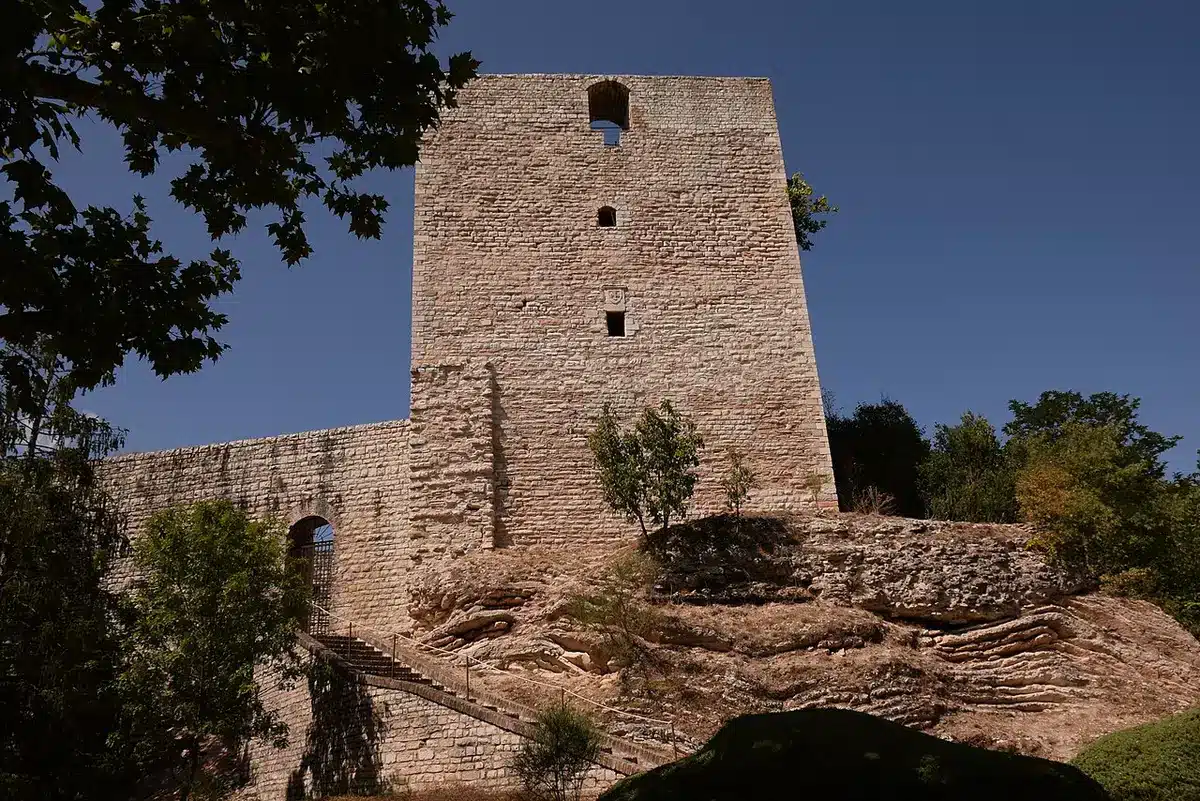
The essentials are the Rocca di Albornoz, the Castello district around Piazza Matteotti with its museums, the Sentinum Archaeological Park and the Abbey of Santa Croce. With more time, add the Rocca di Rotondo and the Cabernardi mine park.
Rocca di Albornoz
The fortress at the top of town was built in 1365 for Cardinal Egidio Albornoz, the papal legate, paid for by selling property confiscated from the Atti family. From the park around it you get a wide view over the valley. Visits are free, with booking recommended and a meeting point at the tourist office. Only 15 people can be inside at once, and the climb to the top uses an original medieval staircase about 55 cm wide, so wear comfortable shoes; children under 14 must be accompanied (Sassoferrato Turismo).
The Castello district and Piazza Matteotti
The upper town is where the history is densest. Palazzo dei Priori, begun in 1335, now holds the archaeological museum; the 15th-century Palazzo Oliva holds the civic art collection; and the Romanesque-Gothic church of San Francesco, documented with its convent since 1248, keeps a 14th-century painted cross of the Rimini school. The collegiate church of San Pietro has works by Tarquinio Salvi, Il Sassoferrato’s father, and the Poor Clares’ church of Santa Chiara has two Madonnas and an Annunciation by Il Sassoferrato himself (I Borghi più belli d’Italia). Churches open on request through the tourist office (Sassoferrato Turismo).
The Borgo district
Down in the lower town, look for the late Renaissance Palazzo Merolli, which encloses the church of Santa Teresa d’Avila (completed in 1682, with an olive-wood Risen Christ from 1630), and Palazzo degli Scalzi on Piazza Gramsci, home of the contemporary art gallery (I Borghi più belli d’Italia).
Rocca di Rotondo
The second fortress, in the countryside, first appears in a document from 1078. A 2015 restoration reopened it, and on clear days the view reaches the Adriatic Sea (Sassoferrato Turismo).
| Sight | What it is | Time needed | Our tip |
|---|---|---|---|
| Rocca di Albornoz | 1365 papal fortress at the top of the Castello | 45 minutes | Book ahead: 15 people at a time |
| Archaeological museum | Finds and mosaic floors from Sentinum in Palazzo dei Priori | 1 hour | Ticket includes the Byzantine reliquaries |
| Civic art collection | Paintings from the 1400s to the 1700s, incl. two by Il Sassoferrato | 45 minutes | Ticket includes the Marche engravers collection |
| Sentinum Archaeological Park | Roman streets, baths and a metal foundry | 1 to 1.5 hours | Guided visits only, book 24 hours ahead |
| Abbey of Santa Croce | Late 12th-century Romanesque abbey built with Roman columns | 30 minutes | Open Sunday afternoons from 3 p.m. |
| Cabernardi mine park | Open-air museum of a sulphur mine closed in 1959 | 1.5 hours | Guided tours at set weekend times |
Which museums can you visit in Sassoferrato?
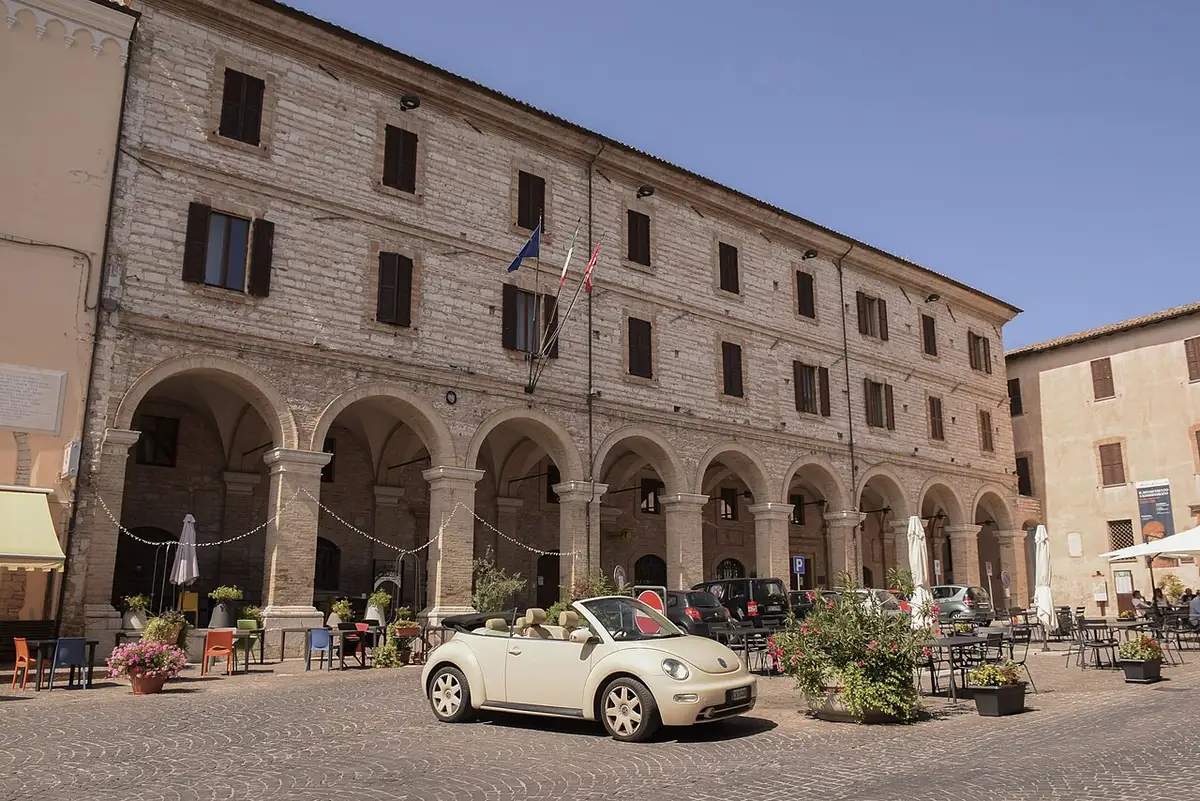
Sassoferrato has several small civic museums, all managed through the tourist office (IAT) at Palazzo Oliva on Piazza Matteotti. A Sassoferrato Museum Card costs €10, covers all the town’s museums and gives a discount at the Cabernardi mine park (Sassoferrato Turismo).
- Museo Civico Archeologico in Palazzo dei Priori: a model of the Battle of the Nations on the ground floor and, upstairs, mosaic floors and everyday objects from Roman Sentinum. The ticket also covers the Raccolta Perottiana, reliquaries gathered by the humanist Niccolò Perotti and given to the town by Cardinal Bessarion in 1473, including the 14th-century Byzantine micro-mosaic Icon of Saint Demetrius (archaeological museum, Raccolta Perottiana).
- Civica Raccolta d’Arte in Palazzo Oliva: paintings from the 1400s to the late 1700s, with panels by Pietro Paolo Agabiti and two canvases by Il Sassoferrato; the ticket includes the Marche engravers collection (Sassoferrato Turismo).
- MAM’S contemporary art gallery in Palazzo degli Scalzi: 680 of the roughly 4,000 works the town has collected through the G.B. Salvi art prize, held since 1951; opened on 6 April 2014 (Sassoferrato Turismo).
- Museum of Folk Arts and Traditions in Palazzo Montanari: about 1,500 objects of rural life; by booking through the IAT at least 24 hours ahead (Sassoferrato Turismo).
Opening hours (2026): the archaeological museum and the art collection follow the tourist office hours, every day from 10:00 to 13:00 and 14:30 to 17:30 from November to March, and 10:00 to 13:00 and 15:30 to 18:30 from April to October; the office is closed on 25 December and 1 January (IAT Sassoferrato). Call +39 0732 956257 or email iat.sassoferrato@happennines.it before a weekend visit.
What is the Sentinum Archaeological Park?
Sentinum is the Roman town just outside Sassoferrato, and its park is one of the most important archaeological sites in Marche. The Battle of the Nations was fought in its territory in 295 BC, when Rome defeated an alliance of Gauls, Samnites, Etruscans and Umbrians. Octavian later destroyed the town in 41 to 40 BC for siding with Antony, and it was rebuilt under Augustus (Sassoferrato Turismo).
The park has two areas, Santa Lucia and Civita, on either side of the road to Fabriano and joined by a footbridge from a large car park. You can see a stretch of cardo and decumanus, an urban and an extra-urban bath complex, granite columns and a metal foundry. Since July 2022 a multimedia installation recreates the baths, the foundry and a Roman house. The site is open only with a guided visit booked at least 24 hours in advance (Sassoferrato Turismo).
A detail most guides miss: Sentinum’s most famous mosaic, the figure of Aion (eternal time), is not here at all. It was lifted and sold in the 19th century and is now in the Glyptothek in Munich. The railway that still crosses the site, built in 1890, is what first exposed the Roman street grid (Sassoferrato Turismo).
Where is the Abbey of Santa Croce?
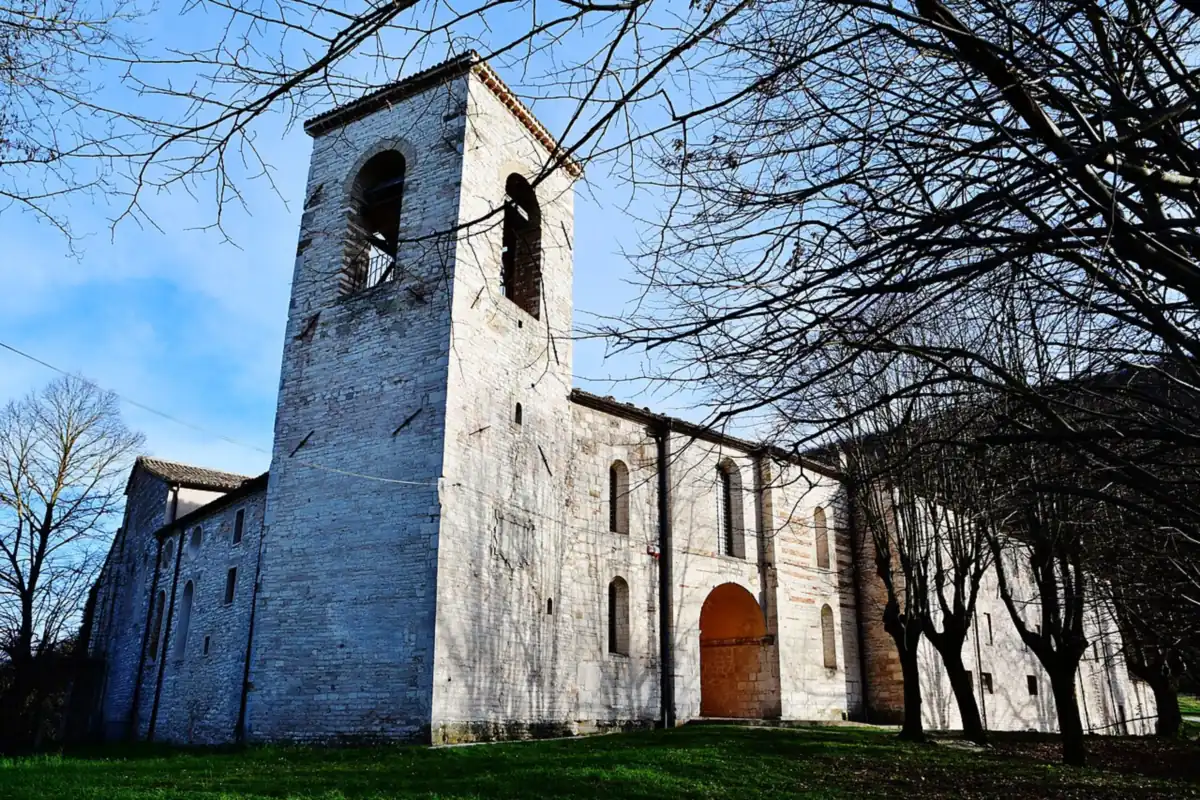
The abbey stands at the foot of Monte Santa Croce, on the opposite side of the valley from the town. The Atti counts built it in the late 12th century, partly with stone and columns taken from Sentinum, and Camaldolese monks lived here from 1613 until 1935 (Sassoferrato Turismo).
It has the Greek-cross plan typical of Marche Romanesque churches, like San Vittore alle Chiuse near Frasassi. Look at the carved capitals, with real and fantastic animals and a Crucifixion, and at Pietro Paolo Agabiti’s 1524 altarpiece of Saint Benedict. The abbey opens on Sunday afternoons from 3 p.m.; for other days, contact the IAT (Sassoferrato Turismo).
What is the Cabernardi sulphur mine?
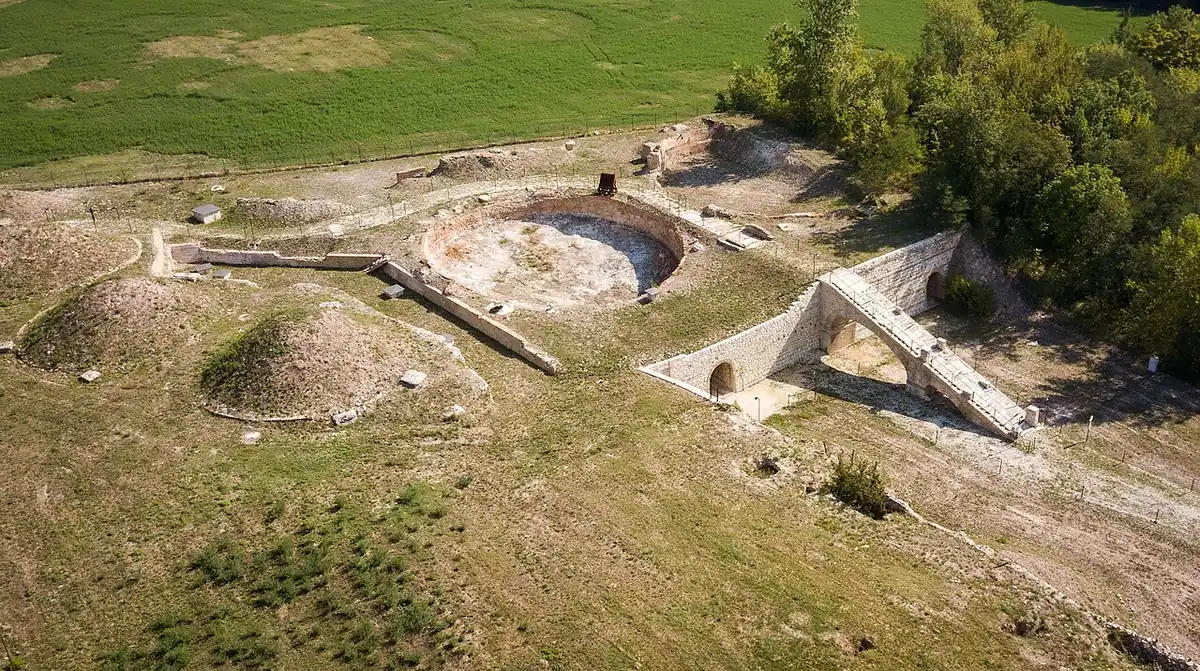
Cabernardi, a hamlet of Sassoferrato, was the site of a sulphur mine that Italia.it calls the most important sulphur mining site in Europe (Italia.it). Mining began in the 1870s; by early 1952 about 1,400 people worked there. When cuts were announced, miners occupied the mine from 28 May to 5 July 1952, a protest remembered as “I Sepolti Vivi” (the buried alive), a phrase coined by Gianni Rodari. Gillo Pontecorvo filmed his documentary “Pane e Zolfo” here in 1956 (Sassoferrato Turismo).
The open-air mine park opened on 5 July 2015 on about two hectares. You see the Donegani shaft, where miners went down, the power station, the sloping calcaroni and the later Gill furnaces where sulphur was melted out, and you walk through a connecting tunnel. Guided tours need booking: from November to March on Saturdays at 16:00 and on Sundays and holidays at 11:00 and 16:00; from April to October on Saturdays at 16:30 and 18:00 and on Sundays and holidays at 11:00, 16:30 and 18:00, plus weekdays in August. Note that the indoor mine museum in the village has been temporarily closed since a municipal order of 18 October 2024, and its ticket office has moved to the park (Sassoferrato Turismo).
Want to see Sassoferrato as part of a private Marche trip?
Sassoferrato rewards planning: Sentinum, the fortress and the mine all open by booking. We take care of that, pair it with a licensed local guide and a long lunch, and our own drivers take you between the town, Santa Croce, Cabernardi and the Frasassi Caves. See our private Marche tours.
One day in Sassoferrato: our plan
This is how we would spend a Saturday or Sunday here, when the most sites are open. Book Sentinum and the Rocca with the IAT at least a day ahead.
- 10:00, Piazza Matteotti: pick up your Museum Card at the IAT in Palazzo Oliva and see the art collection with the two paintings by Il Sassoferrato.
- 11:00, Palazzo dei Priori: the archaeological museum and the Icon of Saint Demetrius. It is the best introduction to Sentinum.
- 12:00, Rocca di Albornoz: climb to the fortress for the view, then walk down through the Castello lanes.
- 13:00, lunch: local Marchigiana beef, cured meats, cheeses or a dish with local saffron or honey.
- 15:00, Sentinum: your booked guided visit of the Roman town and its multimedia rooms.
- 16:30, Abbey of Santa Croce (Sunday afternoon opening), or on a Saturday, the 16:00 guided tour of the Cabernardi mine park from November to March.
- 18:00, aperitivo back on Piazza Matteotti, as Italia.it suggests, before dinner or the drive back.
How to get to Sassoferrato
The easiest way is by car: the drive from Ancona takes just over an hour on the SS76 (Italia.it). Without a car, take the train to Fabriano, then the bus.
- From Ancona by train: regional and InterCity trains link Ancona and Fabriano in about 55 minutes to 1 hour 15 minutes; for example, InterCity 534 leaves Fabriano at 10:31 and reaches Ancona at 11:25 (RFI timetable to 12 December 2026).
- From Rome by train: direct trains run between Roma Termini and Fabriano; the Frecciargento 8851 leaves Fabriano at 8:37 and arrives at Roma Termini at 11:00 (RFI).
- Fabriano to Sassoferrato by bus: ATMA’s line VI1 (Pergola, Sassoferrato, Fabriano) stops at Fabriano station; check times in the ATMA app or on the ATMA website.
- The historic train: on selected dates in autumn 2026, Fondazione FS ran a vintage train from Ancona (9:35) via Fabriano to Sassoferrato (11:32) and Pergola, returning in the evening, on the old Fabriano to Pergola line (Fondazione FS). Watch their calendar for 2027 dates.
Where to eat and what to try in Sassoferrato
This is farming and mountain country, so eat meat, cured meats and cheese. The local products listed by the Borghi più belli d’Italia are Marchigiana breed beef, cheeses and cured meats, saffron and honey (I Borghi più belli d’Italia). The tourist office keeps a list of restaurants, pizzerias and agriturismi in town and in the countryside (Sassoferrato Turismo), and Italia.it recommends an aperitivo on Piazza Matteotti and a gelato at Dolci Emozioni (Italia.it). If food is the heart of your trip, see our Italy food and wine tours.
When is the best time to visit Sassoferrato?
Late spring, early summer and early autumn are the best months: warm, green and quiet (Italia.it). Summer brings the town’s big events; in winter the sites keep shorter hours and the mine park runs weekend tours only.
- Battle of the Nations: a Roman re-enactment at Sentinum in late July, with Roman and Gallic-Samnite camps (Sassoferrato Turismo). In 2026 the program included a “Legionary’s Dinner” among the ruins on 28 July (2026 program).
- Palio della Miniera di Cabernardi: a week of contests between districts that recalls the area’s mining and farming history, with music and food stands (Sassoferrato Turismo).
- G.B. Salvi International Art Prize: the annual exhibition founded in 1951, held in Palazzo degli Scalzi (Sassoferrato Turismo).
- Theater season: ticket holders of the Teatro del Sentino season get a reduction on museum tickets and the Museum Card (Sassoferrato Turismo).
What is near Sassoferrato?
Sassoferrato sits in a rich corner of central Marche, so it fits well into a two or three day loop.
- Fabriano, 20 minutes by car (Italia.it): porticoed streets and the Gothic Palazzo del Podestà from 1255, plus the Paper Museum. Read our Fabriano guide.
- Genga and the Frasassi Caves, in the same corner of central Marche (Italia.it): Europe’s largest karst complex, with a guided tour of about an hour at a steady 14°C (Marche Region tourism).
- Pergola, the last stop of the historic train on the Fabriano to Pergola line (Fondazione FS), and the ATMA bus line VI1 continues there from Sassoferrato.
- Urbino and Jesi for a longer loop: see our guides to Urbino and Jesi, or our list of the most beautiful towns in Le Marche.
Not sure how long to stay in the region? Our guide to how many days to spend in Le Marche helps you build the itinerary.
Sassoferrato FAQ
Is Sassoferrato, Italy worth visiting?
Yes. In one day you can see the Roman town of Sentinum, a 1365 papal fortress, a Romanesque abbey built with Roman columns, two paintings by Il Sassoferrato and the Cabernardi sulphur mine park, with very few crowds. Most sites open by booking through the tourist office, so plan ahead.
Where is Sassoferrato?
Sassoferrato is in the province of Ancona in inland Marche, central Italy, on the eastern side of the Umbria-Marche Apennines near Monte Cucco. Fabriano is about 20 minutes away by car and Ancona just over an hour on the SS76.
Who was Il Sassoferrato?
Il Sassoferrato was Giovanni Battista Salvi (1609 to 1685), a painter born in Sassoferrato and a protagonist of European classicism. You can see two of his canvases in the town’s civic art collection in Palazzo Oliva and three works in the church of Santa Chiara.
What is Sassoferrato known for?
It is known for the Roman town of Sentinum and the Battle of the Nations of 295 BC, the Rocca di Albornoz, the Abbey of Santa Croce, the painter Il Sassoferrato, the G.B. Salvi art prize held since 1951 and the Cabernardi sulphur mine.
Can you visit Sentinum without a guide?
No. The Sentinum Archaeological Park is open only with a guided visit, which you book through the Sassoferrato tourist office (IAT) at least 24 hours in advance. Phone +39 0732 956257 or email iat.sassoferrato@happennines.it.
How do I get to Sassoferrato without a car?
Take a train to Fabriano, which has direct trains from Ancona (about an hour) and Rome (the Frecciargento takes about 2 hours 25 minutes), then ATMA bus line VI1 to Sassoferrato. On selected dates a historic train also runs from Ancona to Sassoferrato.
Is the Cabernardi mine museum open?
The indoor sulphur mine museum in Cabernardi has been temporarily closed since a municipal order of 18 October 2024. The open-air mine park is open for guided tours by booking, on weekends and holidays from November to March and more often from April to October.
Plan your Sassoferrato visit with locals
Sweet Life Italy is a certified incoming tour operator of the Marche Region, based in Castelraimondo and founded by Marco and Ilaria, who live in Marche. We design private, tailor-made trips for 1 to 7 guests across Marche and the rest of Italy, with licensed guides, local food experiences and our own drivers, and we bring more than 13 years in luxury tourism to every itinerary. Sassoferrato can be the Roman and medieval chapter of a private Marche tour or part of one of our private luxury tours of Italy.
Tell us about your trip and we will start with a free video call. After that we send a day-by-day proposal and a free first estimate. Please allow at least 8 weeks before your travel dates.
Featured photo: the Castello, the upper town of Sassoferrato, by Paulacastelli via Wikimedia Commons, CC BY-SA 4.0.