Table of Contents
ToggleVitruvius Rediscovered: The Historic Basilica Unearthed in Fano and How to Explore Its Legacy in Italy
Announce the January 2026 discovery of Vitruvius’ basilica in Fano, calling it “the archaeological discovery of the century.”
Discover the story of Vitruvius and the groundbreaking find of his basilica in Fano. Learn about Roman history and explore Italy with our exclusive travel experiences.
archaeological discovery Italy
Vitruvius Rediscovered a Discovery That Changes Architectural History
In January 2026, the world of archaeology and architecture was shaken by an extraordinary revelation: the discovery of the Basilica of Vitruvius in the Italian city of Fano. This find is not just another Roman ruin—it is the first confirmed building designed by Marcus Vitruvius Pollio, the legendary Roman architect whose principles shaped Western architecture for over two millennia.
For lovers of history, architecture, and Italian culture, this discovery opens a new chapter in understanding the genius of Vitruvius and the grandeur of Roman civilization. And for travelers, it offers a unique opportunity to explore Fano and the Marche region, where history meets elegance
Who Was Vitruvius? The Father of Architecture with his study
Vitruvius was a Roman architect, engineer, and author active during the 1st century BCE. His treatise, De Architectura (known as The Ten Books on Architecture), is the only surviving architectural text from antiquity. This monumental work laid down principles that continue to influence architecture today.
Vitruvian Principles
Vitruvius believed that every building should embody three essential qualities:
- Firmitas (Strength)
- Utilitas (Utility)
- Venustas (Beauty)
These principles became the foundation of architectural theory, inspiring Renaissance masters like Leonardo da Vinci, who famously illustrated Vitruvian concepts in his iconic Vitruvian Man.
Vitruvius’ ideas extended beyond architecture; they touched on engineering, urban planning, and even human proportions. His holistic approach made him a timeless figure in design and aesthetics.
Learn more about Vitruvius:
Vitruvius – Wikipedia
archaeological discovery Italy ; The Discovery: A Basilica Lost for Centuries
The recent excavation in Fano revealed the remains of a Roman basilica described by Vitruvius himself in De Architectura. Archaeologists confirmed the structure’s dimensions match Vitruvius’ specifications: a rectangular plan with eight columns along the longer sides and four along the shorter sides.
Why This Matters
This is the first physical evidence of a building designed by Vitruvius, making it one of the most significant archaeological discoveries of the century. Italian officials have called it “the Tutankhamun of architecture,” and discussions are underway to nominate the site for UNESCO World Heritage status.
The basilica was a center of civic life in Roman times—a place for legal proceedings, commerce, and public gatherings. Its rediscovery offers invaluable insights into Roman urban planning and Vitruvian design principles.
Read the full story:
Discovery of Vitruvius Basilica in Fano
Fano in Roman Times: Fanum Fortunae
Vitruvius work in Fano: Fanum Fortunae
Known in antiquity as Fanum Fortunae (“Temple of Fortune”), Fano was a thriving Roman colony strategically located on the Via Flaminia, the road connecting Rome to the Adriatic coast. Emperor Augustus fortified the city and commissioned the Arch of Augustus, which still stands today as a testament to Fano’s imperial past.
The city played a vital role in trade and governance, and its archaeological heritage includes mosaics, temples, and remnants of Roman walls. Visiting Fano is like stepping into a living museum of Roman civilization.
Explore Fano’s history:
History of Fano
Vitruvius and Leonardo da Vinci: A Timeless Connection
Leonardo da Vinci Vitruvian Man
Vitruvius’ influence reached its zenith during the Renaissance, inspiring artists and thinkers like Leonardo da Vinci. His famous drawing, the Vitruvian Man, illustrates the harmony between human proportions and geometry—a concept rooted in Vitruvius’ writings.
This connection underscores Vitruvius’ enduring legacy, bridging ancient Rome and modern design.
Learn more about the Vitruvian Man:
Vitruvian Man – Wikipedia
Experience Fano and the Marche Region with Sweet Life Italy
At Sweet Life Italy, we specialize in tailor-made travel experiences in Marche region and all Italy for discerning travelers. As a certified incoming tour operator for the Marche region, we create customizable packages that combine history, culture, and luxury.
Our Exclusive Services
- Archaeology & Architecture Tours: Explore the newly discovered Vitruvian basilica, Roman ruins, and Renaissance landmarks.
- Luxury Chauffeur Service: Travel in style with our fleet of elegant Mercedes vehicles (sedans and 7-seater vans) driven by English-speaking professionals.
- Personalized Itineraries: From Fano to Urbino, Ancona, and beyond—immerse yourself in the beauty of central Italy.
Whether you’re an architecture enthusiast, a history lover, or simply seeking an unforgettable Italian vacation, we’ll craft an experience that reflects your passions.
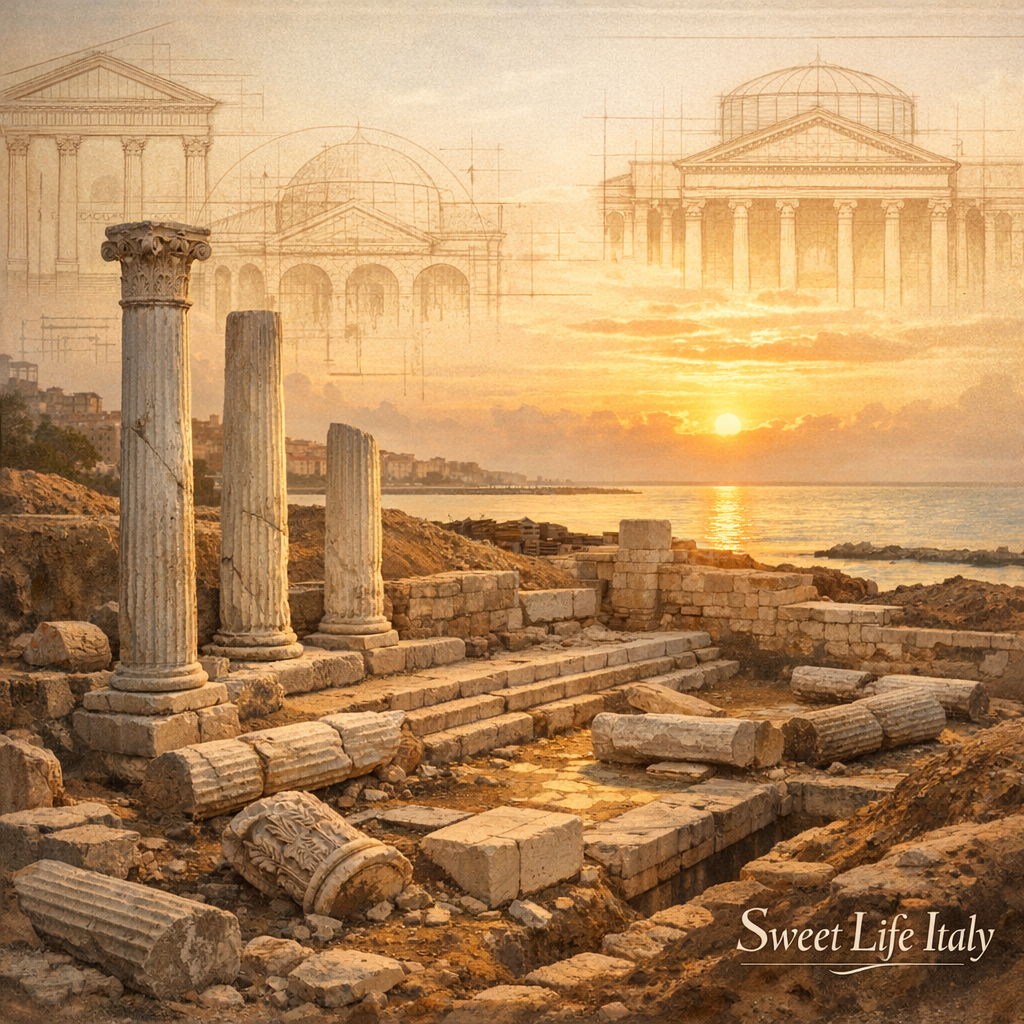
archaeological discovery Italy :Roman ruins in Marche Italy
Roman ruins in Marche Italy